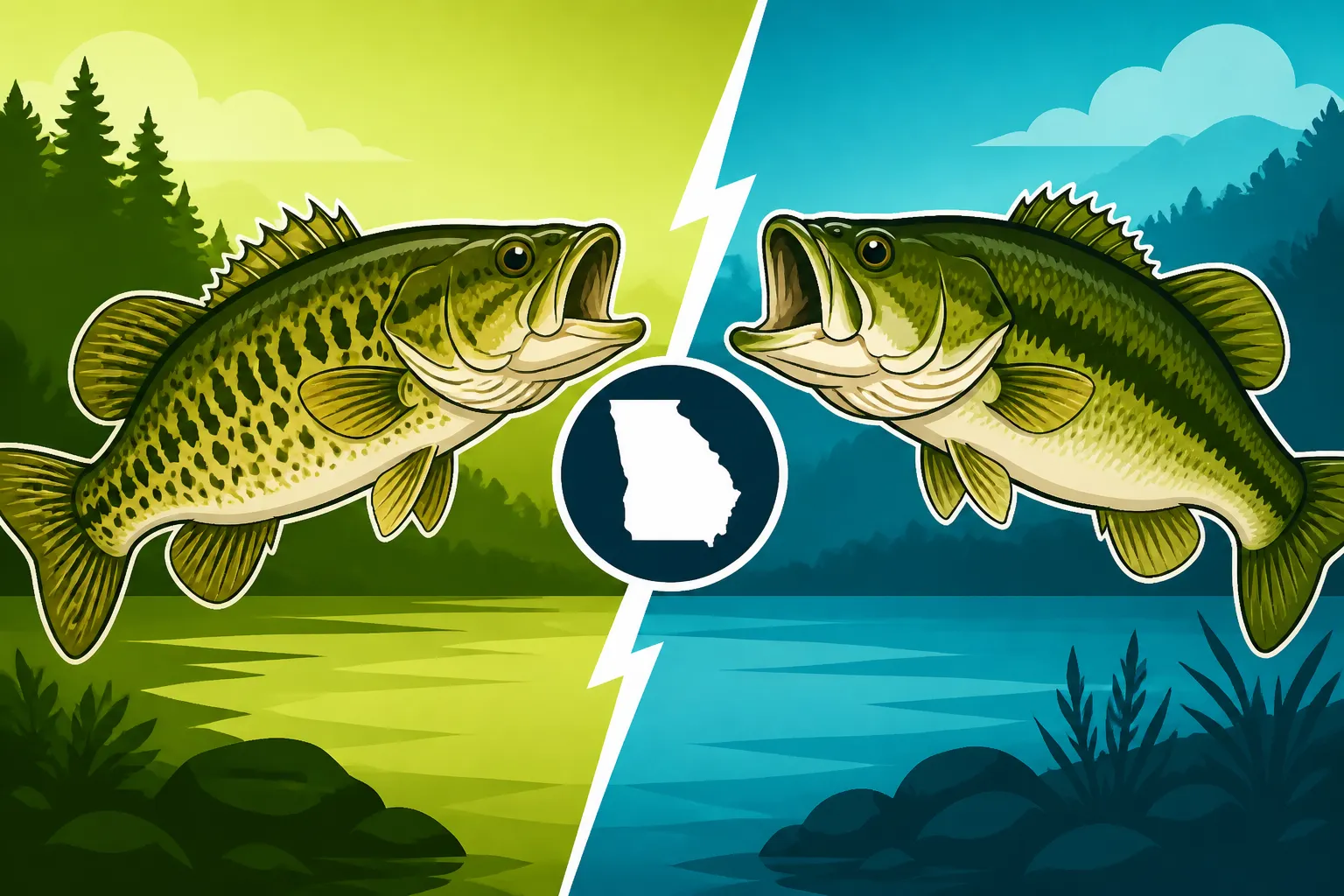
Spotted Bass vs Largemouth Bass: What’s the Difference?
It’s a common scenario for anglers across Georgia: you hook into a feisty bass, reel it in, and then pause, scratching your head. Is it a largemouth, the king of Southern ponds, or one of those hard-fighting spotted bass that have become so prevalent? The confusion is real, and it can be frustrating when you're trying to identify your catch, especially when regulations or personal bests are on the line. This guide is here to clear up that mystery, offering clear distinctions between spotted bass and largemouth bass so you can confidently identify your next catch.
The Tale of Two Bass: Why Identification Matters
For many casual anglers, a "bass is a bass," and while both largemouth and spotted bass offer incredible sport, understanding the differences goes far beyond simple curiosity. It impacts how you fish, where you fish, and even how you comply with local regulations. Misidentifying your catch can lead to disappointment or, worse, unintended rule violations.
More Than Just a Name: Why Anglers Care
Think about it: you've spent hours out on the water, meticulously working your favorite lure, and finally, that satisfying tug. You bring in a healthy, energetic fish. Your first thought might be, "Is this my personal best largemouth?" But then you notice something just a little off. Maybe the spots are a bit more pronounced, or the mouth seems smaller than you'd expect for a largemouth of that size. This isn't just about showing off a picture; it's about understanding the fish you're targeting.
For conservation-minded anglers, knowing the species is vital. Stocking efforts, size limits, and creel limits are often species-specific. For example, some lakes might have stricter limits on largemouth bass to protect trophy populations, while spotted bass might have different guidelines. If you accidentally keep a fish that's technically legal for one species but not the other, you could be unknowingly breaking the rules. Furthermore, from a pure angling perspective, understanding the fish helps you appreciate its unique fight and habitat preferences. It adds a layer of depth to your fishing experience, transforming a simple catch into a learning opportunity.
A Common Conundrum: The Frustration of Mistaken Identity
It's completely understandable to get these two species mixed up, especially when they're young. A small spotted bass can look remarkably similar to a juvenile largemouth, often leading to confusion for even experienced anglers. We've all been there, holding up a fish and trying to remember all the subtle clues. The frustration sets in when you're trying to accurately record a catch for a tournament or explain to a friend exactly what you landed. This isn't a problem unique to beginners; the overlap in appearance, particularly in certain water systems where both thrive, makes it a genuine challenge.
Imagine you're on a new lake, perhaps one like Lake Lanier Fishing Guide, Georgia, which is known for its strong spotted bass population, but also holds plenty of largemouth. You're catching fish left and right, and you want to be sure you're identifying them correctly for your logbook or for bragging rights with your buddies. A quick reference to the key identification points can save you from a mistaken claim and give you confidence in your angling knowledge. Sometimes, having a good field guide or even a quick identification chart available on your phone can be a huge help. You might even consider picking up a detailed fish identification book from a retailer like Amazon to keep in your tackle box or boat for those moments of uncertainty.
Decoding the Differences: Physical Characteristics
While there are many similarities that lead to confusion, largemouth and spotted bass have several key physical distinctions that, once you know them, make identification much easier. It's all about knowing where to look and what subtle features to focus on.
The Jawline is Key: Mouth Size and Maxillary Placement
One of the most reliable ways to differentiate between a largemouth and a spotted bass is by examining their mouths. This is often the first and most obvious clue, especially for larger fish.
- Largemouth Bass: As their name implies, largemouth bass have a significantly larger mouth. If you close its mouth, the maxillary (the upper jaw bone) extends beyond the rear margin of the eye. This gives them that iconic "bucketmouth" appearance that anglers love. It’s almost as if their mouth is disproportionately large for their head.
- Spotted Bass: In contrast, spotted bass have a smaller, more proportionate mouth. When its mouth is closed, the maxillary typically extends to or just slightly beyond the rear margin of the eye, but rarely as far back as a largemouth's. It's a subtle difference at first glance, but once you've seen it a few times, it becomes very apparent. Think of it as a "medium-sized" mouth rather than a "large" one.
This jawline rule is your primary go-to for quick identification. Practice by looking at pictures online or, better yet, with actual fish you catch (and release responsibly!).
The Lateral Line: Patch or No Patch?
Beyond the jawline, another incredibly reliable indicator lies within the lateral line and a specific feature on the tongue.
- Largemouth Bass: Largemouth bass typically have a prominent, dark lateral line that runs horizontally along their side, often looking like a distinct stripe of blotches. However, the most definitive characteristic, and one that absolutely confirms a largemouth, is the absence of a tooth patch on their tongue. If you gently open a largemouth's mouth and run your finger across its tongue, it will be smooth.
- Spotted Bass: Spotted bass also have a lateral line, but it's usually less distinct and more interrupted, often appearing as a series of diamond-shaped blotches. The real clincher for a spotted bass is the presence of a small, rough patch of teeth right in the center of its tongue. This "tooth patch" or "raspy patch" is unique to spotted bass among the black bass species in Georgia.
This tooth patch on the tongue is a foolproof method for distinguishing a spotted bass. It's a tactile test that leaves no room for doubt. Many anglers will hold the fish gently and feel for that patch. If you're looking for detailed fishing maps or even tools to help you hold a fish for inspection, you can often find them on platforms like Amazon.
Dorsal Fins and Scales: Subtle but Significant
While the mouth and tongue are your primary identifiers, a couple of other subtle anatomical differences can further confirm your identification, especially if you're still uncertain.
- Dorsal Fins: Both species have two dorsal fins, but the connection between them differs.
- Largemouth Bass: The spiny front dorsal fin and the soft-rayed rear dorsal fin are almost completely separated or joined by only a very low membrane. You can often press down on the spiny dorsal without significantly moving the soft dorsal.
- Spotted Bass: The two dorsal fins are clearly connected, forming one continuous fin with a noticeable, although not always high, membrane in between. The dip between the two sections is less pronounced than on a largemouth.
- Scales: Look at the scale pattern above the lateral line.
- Largemouth Bass: The scales above the lateral line are typically larger and more uniform.
- Spotted Bass: Spotted bass often have smaller scales above the lateral line, and they may appear somewhat more irregular, though this can be harder to discern quickly. They also have distinct rows of dark spots below the lateral line, which is where they get their name – these spots are usually much more defined than on a largemouth.
Here’s a quick summary table to help you remember the key differences at a glance:
| Feature | Largemouth Bass | Spotted Bass |
|---|---|---|
| Maxillary (Jaw) | Extends past the rear margin of the eye | Extends to or slightly past the rear margin of the eye |
| Tongue | Smooth, no tooth patch | Has a distinct tooth patch in the center |
| Dorsal Fins | Nearly separated or joined by a very low membrane | Clearly connected, forming a continuous fin |
| Body Markings | Prominent dark lateral stripe, fewer distinct spots below it | Distinct rows of dark spots below the lateral line, often diamond-shaped blotches on lateral line |
Habitat, Behavior, and Fishing Strategies
Knowing the physical differences is essential, but understanding where these two bass prefer to live and how they behave can also give you crucial clues and help you tailor your fishing approach. Their environmental preferences often lead them to different parts of the same lake or river.
Where They Live: Preferred Waters in Georgia
While both species can sometimes be found in the same waters, they generally have distinct preferences for habitat within those environments.
- Largemouth Bass: The quintessential ambush predator, largemouth bass love heavy cover. Think shallow, often murkier waters with an abundance of aquatic vegetation, submerged timber, lily pads, docks, or brush piles. They're often found in the backs of coves, along gentle slopes with weed beds, or tucked under overhanging branches. Lakes like Lake Blackshear or many of Georgia's smaller ponds and public fishing areas are prime largemouth territory, offering that perfect blend of shallow water and structure. If you're fishing these areas, you're usually targeting largemouth. They are less tolerant of strong currents and typically prefer slow-moving or still waters.
- Spotted Bass: Spotted bass, on the other hand, are often found in clearer, deeper water with rockier bottoms and steeper drop-offs. They thrive in environments with current, making them common in larger river systems like parts of the Chattahoochee or Flint River, as well as clear, deep reservoirs like Lake Lanier Fishing Guide, Georgia or Lake Hartwell. You'll often find them relating to rocky points, humps, ledges, and submerged timber in deeper zones, rather than hugging the shallow, dense cover preferred by largemouth. Their tolerance for current also means you're more likely to find them in areas below dams or in more riverine sections of reservoirs.
Knowing these habitat preferences can guide your initial identification. If you're pulling a bass off a deep, rocky point on Lake Oconee's Hybrid Striped Bass Fishery, there's a good chance it's a spotted bass. If it's from a shallow, weedy cove, largemouth is a strong contender.
How They Fight: The Experience on the Line
Their habitat preferences also influence their fighting style, which is another way to help you differentiate them once hooked.
- Largemouth Bass: Largemouth are known for their explosive, acrobatic fights, especially near the surface. They often make dramatic jumps, shaking their heads vigorously to dislodge the hook. They'll dive into cover, wrap around submerged trees, or pull hard into weed beds. It's a powerful, topwater-oriented fight that gets the adrenaline pumping. When you hook a big largemouth, you know it because of that immediate, violent head shake and potential leap.
- Spotted Bass: Spotted bass, while perhaps not as prone to spectacular aerial displays, are renowned for their relentless, bulldogging fight. They tend to stay deeper in the water column, pulling hard and making strong, continuous runs. They often feel heavier for their size and will try to dive for structure or scrape the line on rocks. It's a sustained, powerful fight that can feel like you've hooked a much larger fish than you actually have. Many anglers find the spotted bass's tenacity to be incredibly exciting, even if it's less visually dramatic than a largemouth's jump.
If you're wondering what kind of fight you're in for, thinking about the species can help. A fish that keeps diving and pulling hard might well be a spotted bass, whereas one that rockets out of the water could be a largemouth.
Lures and Techniques: Tailoring Your Approach
Understanding the differences in their behavior and habitat also directly impacts the lures and techniques that are most effective for each species. While there's overlap, knowing which bass you're targeting can refine your approach.
- For Largemouth: Given their affinity for cover, lures that can be worked through or around dense vegetation and structure are key. Think spinnerbaits, chatterbaits, Texas-rigged worms, jigs, and frogs. Topwater lures are incredibly effective, especially in low light conditions, mimicking frogs or baitfish near the surface. Punching heavy jigs through matted vegetation is another classic largemouth technique. Anglers might also use crankbaits or swimbaits to cover water along weed lines or timber. If you're looking to stock up on these kinds of baits, you can find a huge variety of Best Lures for Georgia Largemouth Bass on Amazon, ensuring you're ready for any situation.
- For Spotted Bass: Because they favor deeper, clearer water and relate to hard structure, finesse techniques and baits that get down quickly are often highly effective. Drop shots, shaky heads, small jigs, Ned rigs, and smaller crankbaits or swimbaits that mimic baitfish are excellent choices. Vertically jigging spoons or working blade baits on deep humps can also produce great results. They are often less interested in heavy, noisy presentations and prefer more subtle, natural-looking baits. If you're specifically targeting spotted bass on a deep, rocky lake, having a selection of finesse baits from a reliable source is crucial. You might find some excellent options by searching for Best Tackle for Spotted Bass on Lake Lanier on Amazon.
Ultimately, while you can catch both species on a wide array of lures, tailoring your presentation to the specific preferences of largemouth or spotted bass will significantly increase your success rate and make your time on the water more productive.
Conservation and Regulations: Why Knowing Matters More Than Ever
Beyond just the thrill of the catch or the personal satisfaction of identification, accurately distinguishing between largemouth and spotted bass has real-world implications, particularly concerning conservation and compliance with Georgia's fishing regulations. It’s not just about a game; it’s about responsible angling.
Georgia's Specific Rules: Size and Creel Limits
The rules and regulations for fishing in Georgia are designed to manage fish populations sustainably. These rules can vary not only by water body but also by species. This is where misidentification can lead to problems.
- Varying Limits: While many waters in Georgia have a general daily creel limit for black bass, specific reservoirs or river sections may have different size restrictions or creel limits for largemouth bass compared to spotted bass. For instance, a lake might have a 14-inch minimum length limit for largemouth bass to protect larger fish, while spotted bass in that same water might have no minimum length or a different one entirely. If you mistake a legal-sized spotted bass for an undersized largemouth, you might release a fish you could have kept. Conversely, keeping an undersized largemouth because you thought it was a spotted bass could land you in hot water. Always consult the current Georgia Department of Natural Resources (DNR) fishing regulations before you head out. Understanding pages like Georgia Fish Size and Creel Limits or Statewide Largemouth Bass Size Limits in Georgia is critical.
- Special Regulations: Some waters might have "slot limits" or other unique rules designed to promote certain population dynamics. These are almost always species-specific. For example, a slot limit might require you to release all largemouth bass between 15 and 22 inches, but have no such restriction on spotted bass. Knowing which species you have in hand is absolutely paramount for compliance.
Staying informed about these nuances is part of being a responsible angler. Taking a few moments to positively identify your catch ensures you're playing by the rules and contributing to healthy fish populations.
Protecting Our Fisheries: The Angler's Role
Every angler plays a role in the conservation of Georgia's incredible fisheries. Accurate species identification is a small but significant part of that role.
- Data Collection: Fisheries biologists often rely on angler reports and creel surveys to gather data on fish populations. If anglers are consistently misidentifying species, this data can become skewed, potentially leading to less effective management strategies. For example, if spotted bass are over-reported as largemouth, the DNR might make decisions based on inaccurate population counts, which could affect future stocking or regulation changes.
- Sustainable Practices: By correctly identifying your catch and adhering to specific regulations for that species, you are directly contributing to sustainable fishing practices. You're helping ensure that future generations of anglers will have the same opportunities to enjoy catching both largemouth and spotted bass. This includes practicing proper catch-and-release techniques, especially for fish that fall outside the legal harvest limits or those you intend to return to the water. Learning how to properly handle fish is just as important as knowing what kind of fish it is.
Ultimately, being able to tell a spotted bass from a largemouth isn't just about showing off your knowledge; it's about being a more effective, responsible, and conservation-minded angler in the beautiful waters of Georgia. The more you know, the more you can appreciate and protect the diverse fish species that call our lakes and rivers home.
Disclaimer
This article is for general informational purposes only and does not constitute professional advice. Laws, prices and regulations vary by location and change over time. Consult a qualified professional for guidance on your specific situation.