How to Fish a Jig for Largemouth Bass
There's nothing quite as frustrating as knowing those big Georgia largemouth bass are lurking in the depths or nestled in thick cover, yet they stubbornly refuse to bite your usual lures. You've thrown everything but the kitchen sink at them, and still, nothing. That's where the subtle, irresistible appeal of a fishing jig comes into its own. This guide is designed to transform your approach, teaching you the ins and outs of how to fish a jig for largemouth bass, ensuring you have the confidence and know-how to entice even the most wary fish into striking.
Decoding Largemouth Bass Behavior and Preferred Habitats for Jig Success
Before you even think about tying on a jig, it’s crucial to understand the mind of a largemouth bass. These aren't just random swimmers; they're ambush predators with distinct preferences for cover, structure, and water conditions. Jigs, by their very nature, excel at mimicking prey in these exact environments, which is why they become such a potent tool in your arsenal, especially when other presentations fall flat.
Why Jigs Are So Effective for Bass Fishing
Think about what a bass eats: crawfish, bluegill, baitfish that are often hugging the bottom or hiding in dense vegetation. Jigs, with their compact profile and tantalizing skirt pulsations, do an incredible job of imitating these natural food sources. Unlike a fast-moving crankbait or a flashy spinnerbait, a jig offers a more subtle, vertical presentation. This is key when bass are less active due to cold fronts, post-spawn lethargy, or heavy fishing pressure. The jig can be worked slowly, methodically, right in their face, often triggering a reaction strike from a bass that isn't actively chasing. It's a versatile lure that lets you get into tight spots and apply pressure where other baits can't, making it a staple in any serious angler's tackle box. If you're looking for more general information on these powerful fish, be sure to check out our comprehensive guide on Largemouth Bass Fishing in Georgia: The Complete Species Guide.
Key Structures and Cover Where Bass Ambush with Jigs
Largemouth bass are creatures of cover and structure. They love anything that provides shade, a place to hide, or an ambush point. When you’re fishing a jig, you’re aiming to put that bait right where they live.
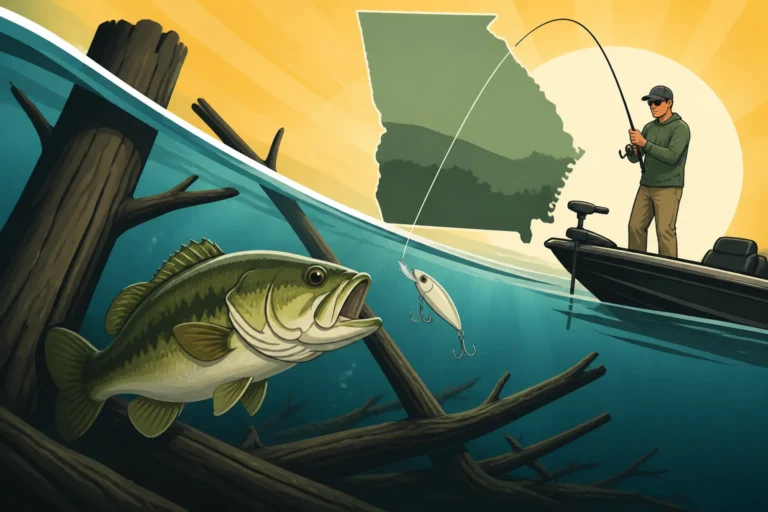
- Wood Cover: This is classic jig territory. Think fallen trees (blowdowns), submerged stumps, brush piles, and standing timber. Bass will often position themselves on the shady side or directly within the tangle of branches. Your jig, designed to be mostly weedless, can be flipped or pitched into these areas with minimal snagging. Imagine working your jig along a massive blowdown on Lake Lanier; you're feeling for every branch, every change in depth, knowing a big bass could be tucked in there. For more details on these specific fishing situations, explore our article on How to Catch Bass Around Submerged Timber.
- Rock and Riprap: Rocky banks, seawalls, and riprap (those big, irregular rocks used to prevent erosion) are excellent places for crawfish to hide, making them prime feeding grounds for bass. A football jig, with its wider head, is perfect for crawling over these irregular surfaces without getting wedged.
- Docks and Piers: The shaded areas under docks and piers, especially those with brush piles or pontoons, offer bass protection and a steady supply of food. Flipping or skipping a jig under these structures is a deadly technique. The trick is to get it as far back into the darkest recesses as possible, where the biggest bass often hang out.
- Vegetation: Hydrilla, lily pads, coontail, and even emergent grasses like cattails all provide excellent cover. Punching a heavy jig through matted vegetation is an aggressive, exciting way to target bass that are seeking shade and oxygen. For areas with sparse or submerged grass, a swim jig can be incredibly effective, mimicking a baitfish darting through the green stuff.
- Ledges and Humps: In deeper waters, especially on reservoirs like Lake Oconee or Clarks Hill, bass will relate to depth changes. Ledges, humps, and submerged creek channels provide excellent ambush points where bass can suspend or cruise. Here, a slower, dragging presentation with a football or even a hair jig can be incredibly productive. These areas often hold schools of bass, and once you find them, you can really stack up the catches.
Equipping Your Arsenal: Essential Gear for Jig Fishing Largemouth Bass
Having the right equipment isn't just about having expensive toys; it's about matching your tools to the task at hand. Jig fishing demands a specific setup that allows for accuracy, power, and sensitivity. Without it, you'll be fighting an uphill battle, missing subtle bites, and losing fish in heavy cover.
Choosing the Right Rod and Reel Combination
When it comes to jigs, you're generally looking for a powerful yet sensitive setup.
- Rod: A medium-heavy to heavy power rod is almost universally recommended for jig fishing. This beefier backbone is essential for driving a stout hook through a bass's jaw, especially when they're buried in thick cover. Look for a fast or extra-fast action tip, which provides the sensitivity to feel subtle bites and the quick responsiveness needed for powerful hooksets. The length will vary, but a 7' to 7'6" rod is a sweet spot for many techniques like flipping and pitching. Brands like St. Croix, G. Loomis, and even more budget-friendly options found on Amazon offer excellent choices. For a detailed discussion on selecting your equipment, consider reading Best Rod and Reel Combo for Largemouth Bass in Georgia.
- Reel: A baitcasting reel with a gear ratio of 7.1:1 or higher is ideal. The faster retrieve rate allows you to quickly pick up slack line after a cast or when a bass charges at you. This speed is critical for keeping tension on the fish and preventing them from spitting the hook or burying themselves in cover. A strong drag system is also paramount, as you'll be putting a lot of pressure on big fish. A reel like a Shimano Curado or a Daiwa Tatula offers the durability and performance needed.
- Sensitivity: This is perhaps the most important aspect of a jig fishing setup. Many jig bites are not aggressive tugs; they're subtle "thumps," "ticks," or simply feeling like your line went "mushy." A sensitive graphite rod transmits these nuances directly to your hand, allowing you to react instantly.
Selecting the Perfect Jigs and Trailers
The world of fishing jigs is vast, but understanding the basics will get you far. Each jig type has a specific purpose and shines in different scenarios. You can find an incredible array of options, including various colors and weights, all conveniently available on Amazon.
| Jig Type | Ideal Conditions | Common Trailer Pairing | Weight Range (oz) |
|---|---|---|---|
| Flipping Jig | Heavy cover (wood, docks, thick vegetation) | Chunk, creature bait, crawfish imp. | 3/8 – 1 oz |
| Football Jig | Open water, rocky bottoms, deep ledges, humps | Crawfish imp., grub, twin-tail grub | 1/2 – 1 oz |
| Swim Jig | Sparse vegetation, open water, mimicking baitfish | Paddletail swimbait, grub | 1/4 – 1/2 oz |
| Arkie Jig | All-around versatile, medium cover, docks, brush | Chunk, crawfish imp., creature bait | 1/4 – 3/4 oz |
| Casting Jig | More open water, less cover, longer casts | Chunk, crawfish imp., grub | 1/4 – 1/2 oz |
- Jig Heads: The head design dictates how the jig moves through cover and on the bottom. Flipping jigs often have a pointed or bullet-shaped head for punching through vegetation. Football jigs have a wider, rounded head that helps them rock and crawl over rocks. Swim jigs typically have a more streamlined head for moving through water cleanly.
- Skirts: Skirts are usually silicone, rubber, or hair (like bucktail). They provide pulsation and flash, mimicking movement. Different colors are crucial. Black and blue are staples for dark water or imitating crawfish. Green pumpkin, brown, and watermelon are excellent natural choices. White or chartreuse can mimic baitfish.
- Trailers: A trailer is a soft plastic bait threaded onto the jig hook, adding bulk, action, and a more lifelike profile. Crawfish imitations, creature baits, and small grubs are popular. Match your trailer size and color to your jig and the forage you're trying to imitate. A bulky trailer on a flipping jig creates a larger profile for big bass in thick cover. A small swimbait on a swim jig gives it a darting, baitfish action. This combination of jig and trailer is a key component to a versatile Tackle Box Setup for Bass Fishing.
The Importance of Line Selection
Your fishing line is the critical link between you and the bass, and for jig fishing, it needs to be chosen carefully.
- Braided Line: For flipping, pitching, and punching heavy cover, braided line is king. Its zero stretch means incredible sensitivity, allowing you to feel the faintest bite, and immense strength for pulling big bass out of heavy cover. Use 30-65 lb test braid, depending on the thickness of the cover. Many anglers will tie a short (12-18 inch) fluorocarbon leader to the braid, especially in clearer water, for stealth.
- Fluorocarbon Line: For techniques where sensitivity and invisibility are paramount, such as dragging football jigs on deeper structure or casting in clearer water, 12-20 lb test fluorocarbon is an excellent choice. It has low stretch and is nearly invisible underwater, making it ideal for wary bass. The best choice often depends on the type of water, from the clear waters of the North Georgia mountains to the more stained reservoirs.
Mastering Jig Presentations and Techniques for Georgia Largemouth
Now that you've got your gear sorted, let's talk about getting that jig in front of a bass. Jig fishing isn't just about casting and reeling; it's a nuanced dance of precision, feel, and patience. Each technique serves a different purpose and is most effective in specific situations you'll encounter on Georgia's diverse waterways.
Flipping and Pitching: Precision in Close Quarters
These are surgical techniques designed for targeting bass in tight, heavy cover. Instead of a long overhead cast, flipping and pitching allow for quiet, accurate presentations with minimal splash.
- Flipping: This technique is used for very close-range targets, typically within 10-15 feet of the boat. You hold the rod in one hand and strip line off the reel with the other. The jig dangles a few feet from the rod tip. You then swing the rod tip forward, releasing the line you’re holding, which propels the jig gently forward. It's a pendulum motion, and the goal is to drop the jig silently into a small opening in cover, like a pocket in a hydrilla mat or a tight spot under a dock on Lake Sinclair. The key is subtlety and precision.
- Pitching: Similar to flipping but for slightly longer distances, up to around 30 feet. You let out a bit more line, hold the jig in one hand, and swing it forward with the rod. As the jig swings, you release it and use your thumb on the reel spool to control the distance, allowing the bait to arc softly to your target. Both techniques are about maintaining control and stealth. Once the jig lands, let it sink on a semi-slack line, watching your line for any twitch or jump—that's often a bite. Then, subtly work it through the cover with small hops and pauses.
Skipping Techniques for Hard-to-Reach Spots
Skipping a jig is a more advanced, but incredibly rewarding, technique. It's especially useful for getting your bait under low-hanging cover like boat docks, overhanging trees, or even shallow rock ledges that are too low for a traditional cast or even a pitch.
- The Motion: Imagine skipping a flat rock across the water. You make a low, sidearm cast, keeping the rod tip close to the water. The jig skips across the surface like a stone, penetrating deep under cover where other lures simply can't reach. The flatter the jig head, the better it skips. This requires practice and a good baitcasting reel with a finely tuned braking system to prevent backlashes.
- Targeting: Focus on the darkest, most shaded areas under docks, where big, reclusive bass often hide. The subtle splash and natural descent of the jig after skipping can often trigger an immediate strike from a bass that rarely sees a lure. It's a fantastic way to reach untouched water and can often result in some of the biggest bites of the day.
Drag and Hop Retrieves for Bottom-Oriented Bass
These retrieve methods are about mimicking crawfish or bottom-dwelling baitfish, and they are incredibly effective when bass are hugging the bottom or relating to deeper structure.
- Dragging: This is a slow, methodical retrieve. You cast your jig out, let it sink to the bottom, and then slowly drag it across the bottom using your rod tip. Think of it like a slow sweep. You're not reeling much; instead, you’re pulling the rod from, say, 9 o'clock to 11 o'clock, then reeling in the slack as you drop the rod back to 9 o'clock. This keeps the jig in constant contact with the bottom, making it appear like a crawfish scuttling along. This is particularly effective with football jigs on rocky ledges or gravel bottoms.
- Hopping: With this technique, you cast your jig out and let it sink. Once on the bottom, you lift your rod tip sharply, making the jig hop off the bottom, then let it fall back down on a semi-slack line. The fall is crucial, as many bites occur as the jig descends. Vary the height and speed of your hops. Sometimes a high, aggressive hop works, other times a subtle "twitch and fall" is more productive. This retrieve can be used with almost any jig type and is especially good around submerged timber or rock piles where bass are actively looking for prey. Pay close attention to your line during the fall; a sudden stop or twitch often indicates a bite.
Adapting Your Jig Fishing Through Georgia's Seasons
Georgia's diverse climate means bass behavior changes dramatically throughout the year. What works on Lake Burton in the spring won't necessarily work on Walter F. George Reservoir in the dead of summer. Understanding these seasonal patterns and adjusting your jig presentation accordingly is paramount to consistent success. For a broader overview of seasonal changes, check out our guide on How Water Temperature Affects Fish Behavior.
Spring: Pre-Spawn and Spawn Tactics
Spring is arguably the most exciting time for bass fishing in Georgia, as largemouth move shallow to spawn. Their behavior is largely dictated by water temperature.
- Pre-Spawn (Water Temps 45-55°F): As water temperatures rise, bass begin to move from their deeper wintering grounds to secondary points and staging areas leading into spawning coves. They are often aggressive as they feed heavily to build energy for the spawn. During this period, a jig can be incredibly effective. Consider pitching jigs around the roots of trees, flooded bushes, or rock transitions along creek channels. A black and blue or brown jig with a bulky craw trailer is a favorite for this time, mimicking large, protein-rich prey. Deeper main lake points on reservoirs like Lake Hartwell can also hold staging fish, so dragging a football jig here can be very productive. For specific regional insights, consider our article on Spring Bass Fishing Patterns on Georgia's Reservoirs.
- Spawn (Water Temps 55-65°F): When water temperatures hit the sweet spot, bass move onto beds in shallow, protected areas. While some anglers prefer sight fishing with lighter baits, a jig can still be a strong choice, especially for larger, more territorial females. Pitch a smaller, more subtle jig (often green pumpkin or natural colors) onto or near a bed. Let it sit there, occasionally twitching it. The bass may pick it up not out of hunger, but to move it off the bed. This is a subtle game of patience and observation.
Summer: Deep Water and Shade Jigging
Summer in Georgia can be brutal, with high temperatures driving bass deeper or into the densest shade they can find. This is where your deep-water jigging skills truly come into play.
- Deep Ledges and Humps: On large reservoirs, bass will often migrate to cooler, deeper water, congregating on offshore ledges, humps, and submerged timber. A heavy football jig (3/4 to 1 oz) is ideal for these scenarios. Drag it slowly along the bottom of these structures, feeling for changes in composition or subtle bites. Fish will often suspend over these structures, so a controlled fall and a long pause can be key. Electronics become your best friend here, helping you locate schools of fish and the specific contours they are using. Think about targeting the bends of old creek channels in Lake Seminole, where big bass will hold at 20-30 feet. If you’re planning a trip to one of the state's most popular lakes, our guide on the Best Time of Year to Catch Bass at Lake Lanier, Georgia will be invaluable.
- Heavy Cover in Shade: Even in summer, some bass will remain shallow, but they’ll bury themselves deep in the thickest, shadiest cover imaginable. This includes dense mats of hydrilla, the deepest recesses under boat docks, or the thickest laydowns along the bank. Punching jigs through vegetation or skipping jigs under docks remains highly effective. Use dark colors like black and blue, which contrast well in low light conditions under thick cover. You can find robust punching jigs and heavy-duty trailers from brands like Strike King and Z-Man on Amazon, perfect for this kind of work.
Fall: Transition and Feeding Frenzies
Fall is a time of transition, as water temperatures begin to cool, and baitfish move into creeks and coves, triggering a feeding frenzy for bass.
- Following the Bait: As baitfish (like shad) move into the backs of creeks and coves, bass will follow. This means both shallow and deeper jig presentations can be effective. Try pitching jigs around shallower cover in creek arms in the mornings, then moving to channel swings and points as the day progresses. The bass are actively chasing, so a swim jig can be incredibly productive, mimicking a darting baitfish.
- Cover and Structure: Bass will still relate to docks, brush piles, and rock, but they'll often be more spread out and shallower than in summer. Covering water becomes more important. Use casting jigs to fan-cast flats and points, or target visible cover with precise pitches. Green pumpkin, browns, and natural baitfish colors are excellent choices as bass gorge themselves before winter sets in.
Winter: Slow and Steady Wins the Race
Winter fishing in Georgia can be challenging, but it offers the chance for trophy bass if you're patient and precise. Bass are lethargic in cold water and won't chase much.
- Deep, Slow Presentations: Bass will often be congregated in deeper, more stable water, such as main lake points, deep channel swings, or even suspended over deep timber. This is the time for a super slow, subtle jig presentation. Dragging a football jig or a hair jig (which has an even more subtle fall) along the bottom is key. Bites will be extremely light, often feeling like just "weight" on your line.
- Vertical Jigging: If you locate schools of bass on your electronics, vertical jigging can be effective. Position your boat directly over the fish and drop a jig straight down, making very small hops or shakes to entice a bite. This is a game of patience and finesse, but it can lead to some incredible catches when other anglers have packed it in. Remember, during winter, the bass are conserving energy, so a slow, easy meal is what they're after.
Disclaimer
Fishing regulations and licensing requirements can change, and it's always your responsibility to be aware of and adhere to the latest rules set by the Georgia Department of Natural Resources. Always check current local regulations before heading out on the water. Stay safe, wear a life jacket, and never fish alone.