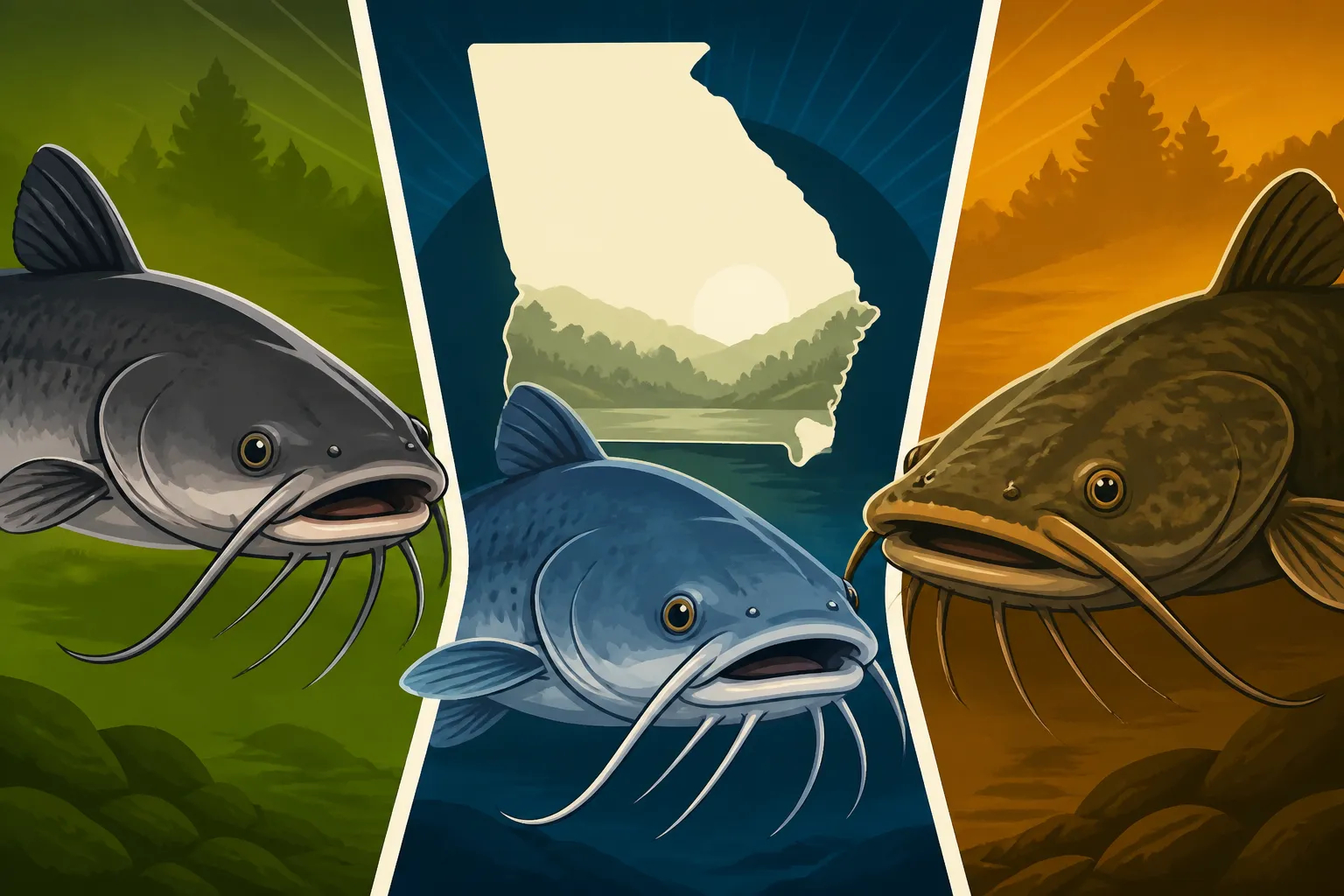
Catfish Species Compared: Channel vs Blue vs Flathead
There's nothing quite like the thrill of a hard bend in your rod, signaling something substantial is on the other end, but once you pull it in, the real question sometimes begins: what kind of catfish is this, anyway? For Georgia anglers, distinguishing between channel, blue, and flathead catfish can sometimes feel like trying to solve a slippery puzzle, especially when you're caught up in the excitement. But understanding the unique characteristics of each of these whiskered powerhouses isn't just about showing off your fish ID skills; it's about becoming a more effective angler. This comprehensive guide will help you identify each species with confidence and understand their behaviors so you can tailor your approach for bigger, better catches across Georgia's diverse waters.
The Classic Whiskered Wonders: Channel Catfish
Ah, the channel cat! This is probably the catfish most people picture when they hear the word "catfish." They're incredibly widespread throughout Georgia, from our vast reservoirs like Lake Lanier and Lake Oconee to smaller ponds, rivers, and even the slower sections of trout streams. They're resilient, plentiful, and a fantastic fight on light to medium tackle, making them a favorite for many anglers, especially those just starting out.
Channel Catfish Identification and Habits
Channel catfish have a sleek, elongated body with a deeply forked tail, which is one of their most distinguishing features – think of a swallow's tail, but for a fish. Their skin is typically olive-brown to slate gray on the back, fading to silvery-white on the belly. The real giveaway, especially on younger or smaller channels, are the dark spots scattered along their sides, although these spots can become less prominent or even disappear entirely as the fish ages. They have eight barbels (whiskers): four on the chin, two on the snout, and two extending from near their eyes. Their head is relatively small compared to their body, and they possess a dorsal fin and pectoral fins, the latter often having sharp, serrated spines that can give you a nasty poke if you're not careful when handling them.
When it comes to habits, channel cats are opportunistic feeders, truly the scavengers of the aquatic world. They'll eat just about anything, which is why they're so successful and widespread. You can find them cruising the bottoms of lakes and rivers, sniffing out decaying organic matter, insects, crawfish, smaller fish, and even fruits and berries that fall into the water. They tend to be most active during low light conditions, especially dawn, dusk, and throughout the night, using their acute sense of smell and those sensitive barbels to locate food in murky waters. They prefer areas with some current in rivers and often hang out near structure like submerged logs, brush piles, or drop-offs in lakes. Understanding these habits is key to successful fishing. You can learn more about their unique characteristics in our guide on Channel Catfish Identification and Habits.
Preferred Habitat and Fishing Strategies
Channel catfish are incredibly adaptable, thriving in a wide range of freshwater environments across Georgia. You'll find them in large impoundments like Lake Hartwell, slow-moving rivers such as the Ocmulgee, and even farm ponds. They prefer areas with soft bottoms, like mud or sand, where they can forage for food, but they'll also relate to submerged structures that offer cover and ambush points. In lakes, look for them around creek channels, humps, and points, especially where there's a good transition from shallow to deeper water. In rivers, they'll congregate in slower eddies, deep holes, and below riffles.
Fishing for channel catfish often involves a classic bottom-fishing setup. A Carolina rig or a simple slip-sinker rig with a hook and weight works wonders. The key is to get your bait down on the bottom where they feed. For bait, the sky's the limit because they're not picky! Stink baits, chicken livers, cut bait (like shad or bream), and even hot dogs are popular choices. Don't forget prepared dough baits, which often come in various pungent flavors specifically designed to attract channel cats. If you're looking to stock up on different bait options or rig components, you can often find a wide array of choices, including specialty catfish baits, on Amazon. When you hook into one, be prepared for a decent fight. They might not be the biggest, but they'll pull hard and put a nice bend in your rod before you bring them to hand.
Giants of the Deep: Blue Catfish
If you're dreaming of a truly massive catfish, the blue catfish is likely the one you're after. These giants are known for their incredible size and fighting power, and Georgia has some fantastic waters where they thrive. While they share some similarities with channel cats, blues have distinct features and behaviors that set them apart.
Blue Catfish Identification and Size
Blue catfish are often mistaken for channel catfish, especially when they're young, but there are some critical differences. Most notably, blue cats have a more pronounced hump on their back, just in front of the dorsal fin, and their head is generally larger and more robust. Unlike channel catfish, adult blue catfish typically do not have spots on their bodies. Their coloration is usually a steely blue or slate gray on their backs, fading to white on their bellies, giving them their namesake. Another key identification feature is their anal fin: blue catfish have a long, straight-edged anal fin with 30-36 rays, whereas channel catfish have a shorter, more rounded anal fin with 24-29 rays. This is one of the most reliable ways to differentiate them once you get them in hand. And like channel cats, they possess a deeply forked tail.
These are the largest catfish species in North America, and Georgia waters are no exception. They can grow to truly astonishing sizes, often exceeding 50 pounds, with some trophy specimens pushing well over 100 pounds! Their size means they are powerful fighters, capable of long, sustained runs and serious head shakes. Targeting blues requires heavy-duty gear and a good dose of patience. When thinking about Blue Catfish Identification and Size, remember to check for the absence of spots and the long, straight-edged anal fin.
Deep Water Habitats and Angling Techniques
Blue catfish are predominantly found in large rivers and reservoirs. In Georgia, prime blue cat territory includes major river systems like the Savannah and the Altamaha, as well as expansive impoundments such as Clarks Hill Lake and Walter F. George Reservoir. They prefer deeper, open water areas, especially around main river channels, humps, and points where current is present. Unlike flatheads, which often relate to structure, blues are more pelagic, meaning they roam open waters in search of food. They are predominantly piscivorous, meaning they eat fish, and they'll actively hunt down shad, herring, carp, and other baitfish. Their diet shifts from smaller invertebrates when young to almost exclusively fish as they grow larger.
Fishing for blue catfish is a serious endeavor that often involves heavier tackle than what you might use for channel cats. A sturdy rod and a powerful reel spooled with strong monofilament or braided line are essential. The best baits for blues are fresh cut bait – especially shad, herring, or even smaller carp – presented on the bottom using a heavy sinker to hold it in place. Live bait, particularly lively shad, can also be incredibly effective. Anglers often employ large circle hooks to ensure good hook sets in their tough jaws. Drifting cut bait along deep river channels or anchoring on humps and points in reservoirs are common and effective strategies. When gearing up, consider a heavy-action rod and a reel that can hold a significant amount of line; Amazon offers a wide range of heavy-duty fishing tackle perfect for tackling these freshwater giants. For more insights on what these fish prefer to eat, check out our guide on Best Bait for Blue Catfish in Georgia Rivers.
The Ambush Predator: Flathead Catfish
The flathead catfish is a very different beast from its channel and blue cousins. While channels and blues are often considered scavengers or opportunistic feeders, the flathead is a true predator, favoring live bait and often found nestled within heavy cover, waiting to ambush its prey. These fish offer a unique challenge and a powerful fight.
Flathead Catfish Identification and Habits
Flathead catfish are immediately distinguishable from channel and blue cats primarily by their head shape, as their name suggests. They have a broad, flattened head, almost shovel-like, with small eyes set high on their skull. Their lower jaw protrudes beyond the upper jaw, giving them a perpetually grumpy or determined look. Their most striking difference is their tail: unlike the deeply forked tails of channel and blue cats, flatheads have a square or slightly rounded tail, with little to no fork. Their coloration is typically mottled brown or yellow, with dark brown or black spots and blotches, providing excellent camouflage against timber and rocky bottoms. Their skin is smooth, devoid of scales, and they also have eight barbels, though they are often shorter and thicker than those of a channel cat.
Flatheads are solitary predators that prefer to hide in thick cover, such as submerged logs, root wads, rock piles, and undercut banks. They're not keen on wide-open spaces. They are voracious eaters, preying almost exclusively on live fish, including bluegill, sunfish, shad, and suckers. They're ambush predators, patiently waiting for an unsuspecting meal to swim by before launching a sudden attack. Like other catfish, they are most active during low light, especially at night, which is often the best time to target them. Understanding their predatory nature and preferred hideouts is key to finding them. Dive deeper into their unique characteristics with our guide on Flathead Catfish Identification and Habits.
Structure-Oriented Fishing and Live Bait Focus
Flathead catfish are found in many of Georgia's larger river systems, including the Flint River, Savannah River, and the lower Chattahoochee, as well as some of our larger reservoirs where substantial timber or rock structures are present. Their preference for heavy cover means you'll need to fish directly in or very close to these snags. This can be challenging, as it often means risking snags and break-offs, but that's where the flatheads are!
When it comes to bait, forget the stink baits and chicken livers; flatheads want live bait. Small bluegill, sunfish, or shad are irresistible to them. A common strategy involves using a heavy-duty ledger rig or a three-way swivel rig with a large live bait hook and a sufficient weight to keep your lively baitfish near the bottom and from swimming into snags too quickly. A strong monofilament or fluorocarbon leader is often preferred for abrasion resistance against sharp rocks and wood. Because they live in heavy cover and grow large, tackle needs to be robust: heavy-action rods, baitcasting reels with a strong drag, and 30-80 pound test line are not uncommon. Fishing at night, when flatheads are most actively hunting, significantly increases your chances. Exploring options for heavy lines and specialty live bait hooks on Amazon can help you gear up for this specific challenge. For a detailed look at the best bait, refer to Live Bream vs Cut Bait for Flathead Catfish.
Spotting the Differences: A Side-by-Side Look
Now that we've covered each species individually, let's put it all together to clearly distinguish between these three fantastic Georgia catfish. Knowing these specific differences will not only help you identify your catch but also inform your fishing strategy.
Physical Distinctions: Fins, Tails, and Heads
The easiest way to tell these species apart often comes down to a few key physical characteristics:
- Tail Shape: This is usually the first thing to look for.
- Channel Catfish: Deeply forked tail, almost V-shaped.
- Blue Catfish: Deeply forked tail, very similar to a channel cat.
- Flathead Catfish: Square or slightly rounded tail, no fork at all.
- Anal Fin: If the tail isn't enough, count the rays on the anal fin.
- Channel Catfish: Shorter, rounded anal fin with 24-29 rays.
- Blue Catfish: Long, straight-edged anal fin with 30-36 rays.
- Flathead Catfish: Shorter, rounded anal fin, similar to a channel cat, but often with fewer rays (14-17).
- Head Shape:
- Channel Catfish: Relatively small, conical head.
- Blue Catfish: Larger, more robust head, sometimes with a slight hump on the back.
- Flathead Catfish: Distinctively broad, flat head with a protruding lower jaw.
- Coloration and Spots:
- Channel Catfish: Olive-brown to gray, often with distinct dark spots (especially when young).
- Blue Catfish: Steely blue or slate gray, generally without spots as adults.
- Flathead Catfish: Mottled brown and yellow, with dark blotches and a camouflage pattern.
Here's a quick comparison table to help cement these differences in your mind:
| Feature | Channel Catfish | Blue Catfish | Flathead Catfish |
|---|---|---|---|
| Tail Shape | Deeply forked | Deeply forked | Square or slightly rounded (no fork) |
| Anal Fin | Rounded edge, 24-29 rays | Straight edge, 30-36 rays | Rounded edge, 14-17 rays |
| Head Shape | Small, conical | Large, robust, sometimes with back hump | Broad, flat, lower jaw protrudes |
| Spots (Adults) | Often present (especially when young) | Generally absent | Absent, but mottled with dark blotches |
| Coloration | Olive-brown to slate gray | Steely blue to slate gray | Mottled brown and yellow |
| Typical Diet | Omnivorous (scavenger, insects, small fish) | Piscivorous (fish, especially shad and herring) | Piscivorous (live fish only, ambush predator) |
| Preferred Habitat | Diverse (lakes, rivers, ponds, moderate current) | Large rivers, deep open lake channels (strong current) | Heavy cover (logs, rocks, timber, slow current) |
Behavioral and Dietary Differences
Beyond the physical, understanding how these fish behave and what they prefer to eat is crucial for successful fishing.
- Diet: This is perhaps the most significant behavioral difference.
- Channel Catfish: The ultimate omnivores. They'll eat almost anything from dead bait, stink baits, and chicken livers to worms, crawfish, and small live fish. They rely heavily on their sense of smell to find food.
- Blue Catfish: Primarily piscivorous (fish-eaters) as adults. They'll actively hunt down schools of baitfish, so fresh cut bait or live bait is usually best. They also use their sense of smell but are more active hunters.
- Flathead Catfish: Strict predators. They almost exclusively prefer live baitfish. They are ambush hunters, waiting in cover for prey to pass by. They use both sight and lateral line to detect vibrations.
- Habitat Preferences:
- Channel Catfish: Highly adaptable. Found in almost any freshwater body, often preferring areas with moderate current or good structure like ledges and creek channels in lakes.
- Blue Catfish: Tend to inhabit large, open river channels and deep sections of reservoirs with strong currents. They roam more widely in search of schooling baitfish.
- Flathead Catfish: Solitary and structure-oriented. They will almost always be found tucked into heavy cover – log jams, undercut banks, rock piles – in rivers and deep lake areas with timber.
- Fishing Time: While all catfish can be caught at various times, their prime activity differs.
- Channel Catfish: Very active at dusk, dawn, and throughout the night.
- Blue Catfish: Often feed actively during the day, especially in deep water, but night fishing can also be productive.
- Flathead Catfish: Almost exclusively a nighttime feeder, emerging from their cover to hunt.
Recognizing these distinctions will help you make informed decisions about where to fish, what bait to use, and even what time of day to target your chosen species. For instance, if you're night fishing with live bait in a snag-filled river, you're almost certainly targeting a flathead!
Tailoring Your Approach: Fishing for Each Catfish Species in Georgia
Knowing what makes each species tick isn't just academic; it directly impacts how you fish for them. A "one-size-fits-all" approach to catfish fishing might yield some results, but to truly excel and target specific species, you need to adjust your tactics.
Gear and Bait Adjustments for Targeted Catfishing
The tackle you choose and the bait you present are paramount to success.
- For Channel Catfish: Since they don't typically grow to extreme sizes and are opportunistic feeders, a medium-action spinning or baitcasting rod and reel combo spooled with 10-20 pound monofilament line is often sufficient. A simple slip-sinker rig or a Carolina rig works beautifully. As for bait, anything pungent and smelly is usually a winner: chicken livers, cut hot dogs, prepared stink baits, or even fresh worms. You don't need giant hooks; a 2/0 to 4/0 circle hook or J-hook will do the trick. If you're looking to get started, you can find complete beginner catfish kits or individual components like different types of hooks and weights on Amazon. Don't forget to check out our deep dive into Best Bait for Channel Catfish in Georgia.
- For Blue Catfish: These fish demand heavy-duty gear. Think heavy to extra-heavy action rods, robust baitcasting reels with a good drag system, and line in the 30-80 pound test range (braid is a popular choice for its strength and sensitivity). Your rigs should be stout, often involving 6-8 ounce sinkers to hold bottom in current, and large circle hooks (8/0 to 10/0) to accommodate big chunks of cut bait. Fresh cut bait from oily fish like shad or herring is king, but live sunfish can also be deadly. You'll likely be targeting deeper water, so a good fish finder can be invaluable.
- For Flathead Catfish: Fishing for flatheads is about power and precision. You'll need extra-heavy action rods, high-capacity baitcasting reels with a strong drag, and 40-80 pound braided or heavy monofilament line, often with a tough leader. Rigs usually involve a heavy sinker to keep live bait anchored near cover, and large, sturdy circle hooks (6/0 to 10/0) are a must for hooking into their tough mouths. The golden rule for flatheads is live bait – small bluegill, sunfish, or lively suckers. They're usually found in dense cover, so be prepared for a fight that might involve pulling them out of snags. Best Rod for Catfish Fishing on Georgia Rivers has more information on choosing the right gear.
Locating and Targeting Specific Catfish in Georgia Waters
Where you cast your line will also depend heavily on which species you're after.
- Channel Catfish Locations: Since they're so widespread, you have a lot of options. In lakes, look for them around creek mouths, points, humps, and the edges of submerged timber. In rivers, target slower eddies, deep bends, and pools. Fishing near public fishing areas or designated bank fishing spots can be highly productive for channels. Our guide on Best Catfish Fishing Spots in Georgia offers some excellent starting points.
- Blue Catfish Locations: Focus on large river channels in big reservoirs and major river systems. Look for deep holes, pronounced ledges, and areas where current concentrates baitfish. Drifting large chunks of cut bait or anchoring on deep structure are common strategies. Many anglers will spend time scouting these deeper areas with sonar before deploying their lines.
- Flathead Catfish Locations: This is all about cover. In rivers, search for large log jams, downed trees, undercut banks, and rock piles. In reservoirs, locate areas with extensive submerged timber or deep rock formations. Flatheads will be tucked inside or immediately adjacent to this cover. Presenting your live bait as close as possible to these ambush points, often at night, is the most effective tactic. Expect to lose some rigs, but the reward of a powerful flathead is worth it.
By understanding these nuances in identification, behavior, and fishing techniques, you'll be well on your way to becoming a more skilled and successful catfish angler, whether you're chasing the plentiful channel cats, battling the monstrous blues, or wrestling with the reclusive flatheads in Georgia's rich waters.
Disclaimer
This article is for general informational purposes only and does not constitute professional advice. Laws, prices and regulations vary by location and change over time. Consult a qualified professional for guidance on your specific situation.