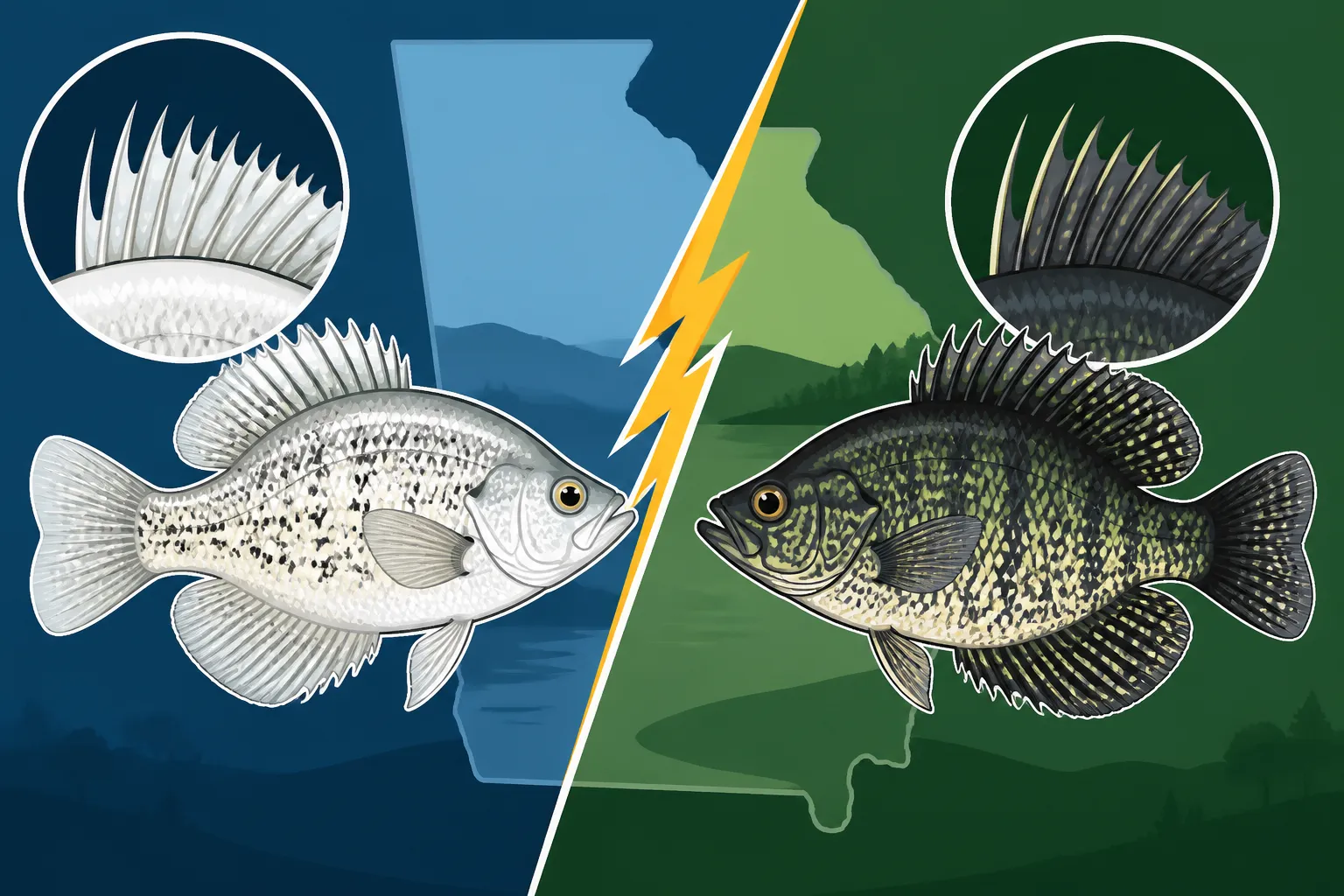
White Crappie Fin and Spine Count vs Black Crappie
It can be incredibly frustrating to reel in a beautiful crappie, look at it closely, and still not be absolutely sure if you’ve caught a white crappie or a black crappie. Many anglers struggle with this common identification challenge, especially since both species share many traits and often inhabit the same waters. This comprehensive guide is here to clear up the confusion, focusing specifically on the crucial fin and spine counts that will help you confidently tell these fantastic fish apart every single time.
The Perennial Crappie Identification Challenge
If you've spent any time on Georgia's lakes and rivers targeting crappie, you know firsthand how similar these two species can appear at a glance. They both have that distinctive compressed, disc-like body shape, large eyes, and generally silvery coloration. It's easy to assume "a crappie is a crappie," especially when they're biting hot and heavy, and you're just focused on getting another one in the boat. But beneath those superficial similarities lie some key differences that can make a real impact on your fishing success and even your understanding of their behavior.
Why It's So Easy to Mix Them Up
One of the biggest reasons anglers, both novice and experienced, often confuse black and white crappie is their shared habitat. In many of Georgia's prime crappie lakes, you'll find both species coexisting. For example, Lake Sinclair Fishing Spots and Lake Oconee Fishing Guide, Georgia are known for holding both black and white crappie populations, often in similar areas like submerged timber, brush piles, or around docks. When you're pulling fish out of the same brush pile, it’s only natural to assume they’re all the same kind. Their feeding habits can also overlap significantly, especially when forage is abundant, further blurring the lines in an angler's mind. Plus, environmental factors like water clarity and diet can subtly alter a crappie's coloration, making definitive identification by color alone unreliable.
Why Proper Identification Matters
While it might seem like a minor detail, knowing the difference between a white crappie and a black crappie can genuinely enhance your fishing experience. For starters, understanding which species you're catching helps you fine-tune your techniques. Black crappie, for instance, tend to prefer clearer, cooler water with more vegetation, while white crappie often thrive in murkier, warmer conditions. If you're consistently catching one species over the other, it tells you something important about the water you're fishing and the type of structure you've found. This knowledge can guide your future choices for Best Crappie Lakes in Georgia or even specific spots within a lake. Additionally, while Georgia's creel and size limits for crappie are generally uniform across both species, knowing which one you're targeting or catching can aid in reporting and conservation efforts, contributing valuable data to fisheries management. And let's be honest, it's also a point of pride to correctly identify your catch and deepen your knowledge of the fish you pursue.
Unpacking the White Crappie's Distinctive Features
When it comes to identifying crappie, we need to get a little technical, but I promise it's worth it. The most reliable way to tell the difference isn't by their general coloring or spots, which can be inconsistent, but by counting their spines. Specifically, we're looking at the dorsal fin and the anal fin. The dorsal fin is the one on the fish's back, and the anal fin is located on the underside, towards the tail.
The Dorsal Fin: A Key to White Crappie Identity
For a white crappie, the dorsal fin is your first major clue. If you gently extend the dorsal fin on a white crappie, you'll consistently count six (6) sharp, bony spines. These aren't soft rays; they're rigid, pointed spines that stand erect. This count is remarkably consistent and is the single most definitive characteristic for a white crappie.
Think of it like this: if you're out on the water, maybe even trying How to Jig for Crappie, and you pull in a fish that looks like a crappie, the first thing to do is carefully pinch the base of that dorsal fin and count those spines. Six spines mean you've got yourself a white crappie. It's a precise biological trait that rarely deviates, making it an invaluable tool for identification. You can even confirm this with a good field guide or by checking reliable online resources after a productive day.
Anal Fin Spines and Body Markings
Beyond the dorsal fin, the white crappie also typically has six (6) spines in its anal fin. This mirrors the dorsal fin count and provides another layer of confirmation. While the dorsal fin count is often enough, checking both can solidify your identification.
Now, let's talk about those body markings. White crappie are often characterized by their distinct vertical bars running down their sides. These bars can vary in prominence depending on the individual fish, its age, and its environment, but they are generally present and appear as organized stripes rather than random splotches. Sometimes these bars can be quite faded, especially in very clear water or on lighter-colored fish, which is why relying solely on them can lead to misidentification. However, in combination with the spine count, these bars become a strong secondary indicator. The overall body shape of a white crappie also tends to be a bit more elongated compared to the black crappie, but this is a subtle difference that takes a keen eye and practice to discern accurately.
White Crappie Habitat and Behavior Notes
Knowing where white crappie tend to hang out can also give you a head start on identification before you even get a bite. White crappie generally prefer murkier, turbid waters with less vegetation and more open water areas. They're often found in the larger, warmer reservoirs and slower-moving river sections across Georgia. They are quite tolerant of less-than-pristine water conditions and can thrive in areas where black crappie might struggle.
You'll frequently find them relating to larger, more sparse structures like standing timber, deeper brush piles, or channel edges, particularly in areas with good current. They tend to school up more tightly and actively, making them a fantastic target for anglers who enjoy trolling or spider rigging with multiple rods. If you're fishing a relatively large, somewhat stained reservoir and pulling fish off deep brush piles in open water, there's a good chance you're encountering a lot of white crappie. Understanding these tendencies, as covered in White Crappie Identification Guide, can help you anticipate your catch even before you see its fins.
Decoding the Black Crappie's Defining Characteristics
Now that we've dug into the white crappie, let's turn our attention to its equally popular cousin, the black crappie. Just like with the white crappie, the key to confident identification lies in the spine count of their fins. This is where we find the most consistent and glaring differences.
Counting the Black Crappie's Dorsal Spines
Here's the critical difference: a black crappie will almost always have seven (7) or eight (8) dorsal fin spines. This is the definitive characteristic that separates them from white crappie. While white crappie are locked in at six, black crappie give you a slightly larger range, but always more than six.
When you bring a crappie to hand, gently lift that dorsal fin. If you count seven or eight rigid spines, you can be confident you're holding a black crappie. This is a game-changer for identification, especially when their color patterns might be confusing due to water conditions or individual variations. This reliable spine count is the cornerstone of Black Crappie Identification: A Georgia Angler's Guide. It's a simple, undeniable fact you can observe right there on the water, no guesswork needed.
Anal Fin Spines and Their "Peppered" Appearance
Mirroring the dorsal fin, black crappie typically also boast seven (7) or eight (8) spines in their anal fin. So, if you've already counted seven or eight dorsal spines, checking the anal fin for a similar count merely reinforces your initial observation. This dual confirmation system makes misidentification almost impossible once you get the hang of it.
Beyond the spine count, black crappie have a distinct visual pattern. Instead of the vertical bars found on white crappie, black crappie are adorned with a more random, scattered pattern of dark spots and speckles all over their body. This often gives them a "peppered" or mottled appearance. These spots are usually quite prominent and distributed without any particular linear organization. In some fish, especially those from dark, tannin-stained waters, these spots can be so numerous and dense that the fish appears quite dark overall, living up to its "black crappie" name. This speckling, combined with the higher spine count, makes for a solid identification.
Black Crappie Habitat and Behavior Notes
Understanding the preferred environment of black crappie can help you predict which species you're more likely to encounter. Black crappie are generally found in clearer, cooler waters with abundant submerged vegetation, stumps, brush piles, and other forms of cover. They love hiding among weeds, lily pads, and fallen trees. You'll often find them in North Georgia lakes and more pristine river backwaters where water clarity is higher.
They tend to be less tolerant of turbidity and prefer less current than white crappie. Their preference for heavy cover makes them excellent targets for anglers using tactics like pitching jigs or small minnows right into dense structure, where they might be ambushing prey. If you're fishing a clear-water lake with lots of visible vegetation and woody cover, you're likely in prime black crappie territory. Knowing these habitat preferences can inform your approach, whether you're fly fishing for trout or targeting crappie.
Side-by-Side: White Crappie vs. Black Crappie Comparison
Now that we've broken down the individual characteristics, let's put them side-by-side. The goal here is to make it incredibly clear how you can differentiate between these two popular panfish, not just by their fin and spine counts, but by combining all the visual cues and behavioral insights we've discussed. This comparison will serve as your ultimate cheat sheet on the water, helping you master Crappie Compared: Black vs White in Georgia Waters.
The Definitive Fin and Spine Count Differences
This is where the rubber meets the road. The dorsal fin spine count is the most reliable identifier, but the anal fin count provides excellent secondary confirmation. Here’s a simple table to keep it straight:
| Feature | White Crappie | Black Crappie |
|---|---|---|
| Dorsal Fin Spines | 6 | 7 to 8 |
| Anal Fin Spines | Typically 6 (can be 5-7) | Typically 7 to 8 (can be 6-9) |
As you can see, the difference is clear and consistent. Six dorsal spines for a white crappie, and seven or eight for a black crappie. This is the single most important piece of information to remember. Practice counting on your next few catches, and you'll quickly become an expert. A good, waterproof field guide (many are available on Amazon) can be a great companion to keep these facts fresh in your mind while you're out fishing.
Beyond Spines: Other Visual Cues and Habitat Preferences
While the spine count is definitive, other characteristics can help reinforce your identification, especially once you're familiar with the primary method.
- Body Shape: White crappie tend to have a slightly more elongated, torpedo-like body, whereas black crappie are often described as having a more round, "dinner plate" or "sunfish-like" shape. This difference can be subtle, especially for smaller fish, but becomes more apparent with larger specimens.
- Mouth Size: The white crappie's mouth typically extends to or slightly past the middle of its eye. The black crappie's mouth usually reaches just below the middle of the eye. Again, a subtle difference, but useful if you're really scrutinizing a fish.
- Coloration and Pattern: As discussed, white crappie have those distinct vertical bars, while black crappie have a more scattered, "peppered" pattern of spots. While color can vary, the pattern of the markings is generally consistent.
- Habitat: White crappie often prefer larger, murkier reservoirs and slower rivers, frequently found in open water or around scattered large structures. Black crappie lean towards clearer, cooler water with dense aquatic vegetation and woody cover. Knowing the type of water you're fishing can give you a strong hint before you even see the fish. This insight is crucial for targeting Best Crappie Lakes in Georgia.
Practical Tips for Anglers on the Water
So, how do you put all this knowledge into practice when you're actively fishing?
- Catch and Observe: When you land a crappie, take a moment before you unhook it. Gently hold the fish and focus on that dorsal fin.
- The Spine Count is King: Carefully extend the dorsal fin and count the rigid spines. Remember: 6 means white crappie, 7-8 means black crappie. Don't worry about counting the soft rays behind the spines; focus only on the stiff, pointed ones.
- Look for Secondary Cues: Once you have the spine count, quickly check for the body pattern. Are there distinct vertical bars (white crappie)? Or is it a scattered, peppered appearance (black crappie)?
- Consider the Environment: Think about where you caught the fish. Was it in clear, weedy water, or a turbid, open reservoir? This helps confirm your identification.
- Practice Makes Perfect: The more crappie you catch and identify, the faster and more confident you'll become. Soon, you'll be able to tell the difference at a glance. You might even find yourself reaching for different Best Jig Colors for Crappie Fishing or How to Rig a Minnow for Crappie techniques based on which species you're primarily encountering.
- Use Tools: A small, compact fishing scale with an integrated measuring tape, easily found on Amazon, can help you measure your catch, and many anglers even keep a small, laminated crappie ID card in their tackle box for quick reference.
By combining the definitive spine count with visual cues and habitat knowledge, you'll be able to confidently identify your crappie catches every time you're out on the water. This understanding will not only boost your angling knowledge but also help you become a more effective crappie angler in Georgia's diverse fisheries. Don't forget that consistent practice, like reviewing our guide on Crappie Fishing in Georgia: Black and White Crappie Guide, will solidify your skills.
Disclaimer
This article is for general informational purposes only and does not constitute professional advice. Laws, prices and regulations vary by location and change over time. Consult a qualified professional for guidance on your specific situation.