Best Kayak Anchor for Georgia Rivers
If you've ever tried to fish a promising eddy or a swift-moving run on a Georgia river from your kayak, you know the struggle is real. Just when you get into position, the current grabs you, and suddenly you're downstream, waving goodbye to that perfect casting spot. It's incredibly frustrating to spend more time paddling and repositioning than actually fishing. This guide is all about helping you conquer those currents by choosing and using the best kayak anchor for your Georgia river adventures, ensuring you stay put when it matters most.
Why River Kayak Anchoring is a Unique Challenge
Anchoring a kayak in a lake is one thing – typically, you're dealing with minimal current, and a simple grapple anchor might do the trick. But rivers, especially those here in Georgia like the Chattahoochee or the Flint, are a whole different beast. The constant flow of water, varied bottom compositions, and potential hazards mean you can't just throw any old weight overboard and expect to stay put. It takes a bit more thought and the right gear.
Understanding River Currents and Bottom Composition
Rivers are dynamic environments, constantly changing based on rainfall, dam releases, and the natural contours of the land. A slow-moving section can quickly turn into a raging torrent after a heavy rain, or a generation schedule from a hydro dam might increase flow dramatically. This variability means your anchor needs to be versatile.
Then there's the riverbed itself. Unlike many lakes with consistent muddy or sandy bottoms, Georgia rivers can offer a smorgasbord of challenges:
- Rocky Bottoms: Full of boulders, gravel, and submerged ledges. A grapple anchor can be fantastic here, allowing its tines to hook onto rocks. However, it also has a higher risk of getting permanently snagged.
- Sandy/Silty Bottoms: Common in slower, wider stretches. Fluke anchors are often best, designed to dig into soft substrate. But in a strong current, a lighter fluke might just drag.
- Muddy Bottoms: Similar to silty, but often deeper and stickier. Fluke anchors can work, but a heavier option or a drag chain might be needed to really dig in and hold.
- Woody Debris: Submerged logs, branches, and root systems are common in many river sections. These are notorious anchor snaggers and can be genuinely dangerous if your anchor gets caught in a strong current, potentially flipping your kayak. You always want to be able to release your anchor quickly in such situations.
Challenges of Anchoring in Flowing Water
Beyond the bottom type, the sheer force of moving water poses significant challenges. Imagine trying to hold a kite steady in a strong wind – that's a bit like a kayak anchor trying to hold against a river current.
- Dragging: A common frustration. You drop your anchor, feel it catch, and then slowly but surely, you start drifting. This usually means your anchor isn't heavy enough or isn't designed for the bottom type you're on, or the scope (the ratio of anchor line to water depth) is too short.
- Snagging: The bane of every river angler. Your anchor gets wedged between rocks or wraps around a submerged log, and no amount of pulling will free it. This often leads to losing expensive gear or, worse, putting yourself in a dangerous situation trying to retrieve it.
- Yawing and Spinning: Even if your anchor holds, the current can push your kayak from side to side, making it difficult to maintain a consistent casting angle. An anchor trolley helps immensely with this, allowing you to position your anchor point along the length of your kayak. We'll dive into anchor trolleys a bit later.
- Depth and Line Management: Rivers aren't uniform. The depth can change dramatically within a few feet, especially in sections with rapids or deep pools. Managing your anchor line quickly and efficiently is crucial. Too much line and you're dragging, too little and your anchor won't set properly.
Understanding these unique river dynamics is the first step in choosing an anchoring system that genuinely works for your Georgia fishing excursions.
Types of Kayak Anchors for Rivers
When it comes to picking an anchor for your kayak on Georgia's rivers, you've got a few main types to consider. Each has its strengths and weaknesses, making some better suited for certain conditions than others. The goal is to find one that holds well without becoming a permanent resident of the river bottom.
Grapple Anchors for Rocky Bottoms
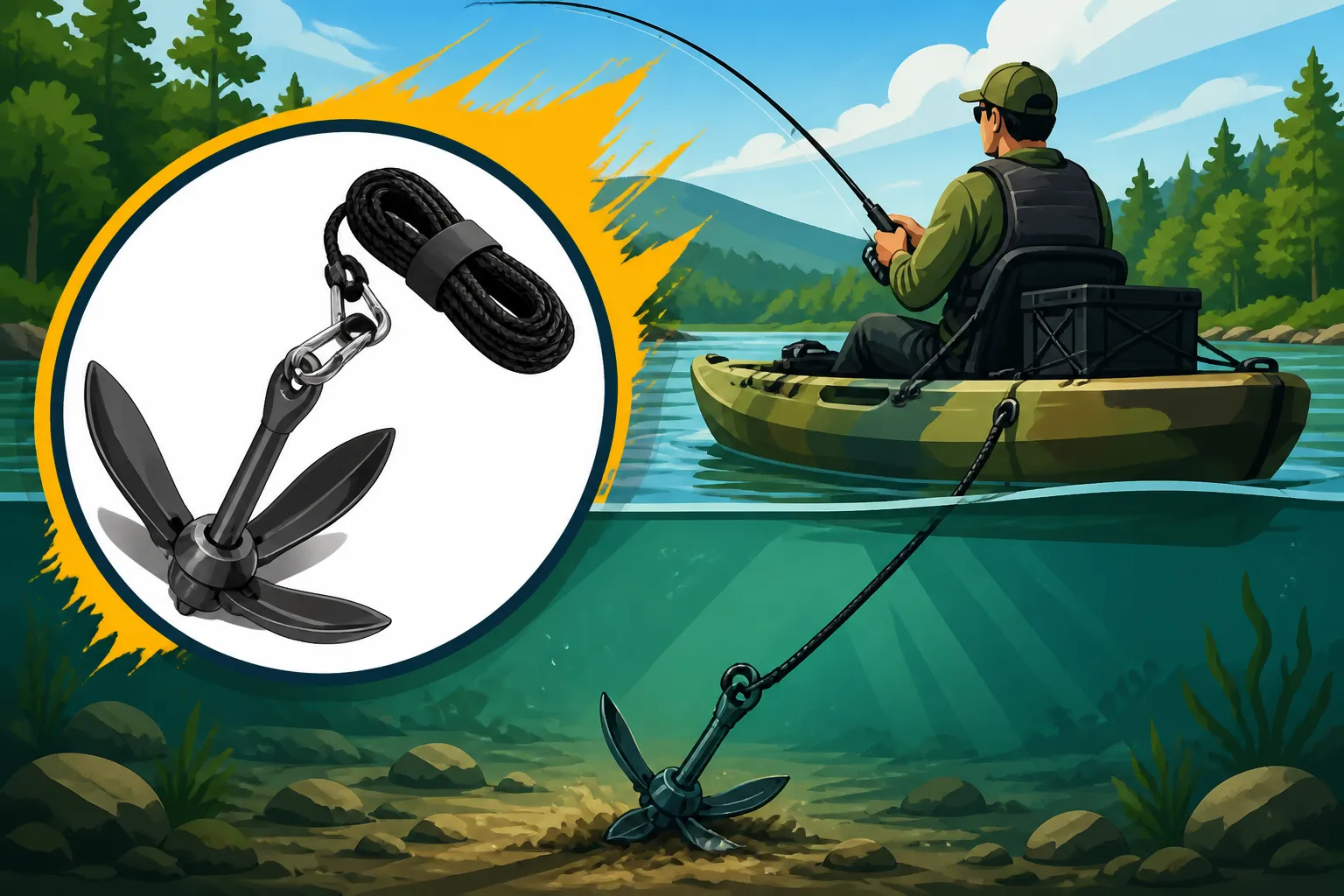
The grapple anchor, sometimes called a folding anchor, is a popular choice for kayak anglers, and for good reason. It typically has four prongs or flukes that fold out, designed to catch onto irregularities like rocks, logs, or even thick vegetation.
Pros:
- Excellent in Rocky Areas: Those prongs are fantastic for snagging onto rocks and holding firm, which is a major plus in many North Georgia trout streams and other rocky river sections.
- Compact: Many grapple anchors fold up, making them easy to store in a small kayak hatch or bungeed to the deck. This is a huge benefit when space is at a premium.
- Versatile: Can also work in some vegetative or somewhat soft bottoms if the prongs can dig in, though they aren't as efficient as a fluke anchor in purely soft material.
Cons:
- High Snag Risk: The very thing that makes them good in rocks can also make them a nightmare. A prong can get permanently wedged in a crevice, leading to a lost anchor. This is where a "breakaway" system becomes critical, allowing you to pull the anchor from a different angle if it gets stuck.
- Less Effective in Soft Mud/Sand: Without hard points to grab, a grapple anchor can just slide over soft mud or sand, especially in a strong current.
Many anglers find themselves reaching for a grapple anchor from brands like Bass Pro Shops or smaller specialized kayak fishing outfits because of their compact size and holding power in specific river conditions.
Fluke or Danforth Anchors for Softer Beds
The fluke anchor, often referred to as a Danforth-style anchor, is characterized by its broad, flat flukes designed to dig deep into soft bottoms like sand, mud, or silt.
Pros:
- Superior in Soft Bottoms: If you're fishing a wide, slower section of river with a predominantly sandy or silty bed, a fluke anchor will generally provide excellent holding power. It buries itself, creating a strong grip.
- Less Snag Risk in Soft Areas: Because it's designed to dig in rather than hook onto protrusions, it has a lower risk of getting snagged in truly soft, clear bottoms.
Cons:
- Poor in Rocky Areas: The flat flukes simply won't get a grip on rocky or hard clay bottoms. They'll just skip and drag.
- Bulkier: Fluke anchors typically don't fold up as compactly as grapple anchors, requiring a bit more storage space on your kayak.
- Needs to Set: For a fluke anchor to work, it needs to be dragged a bit to "set" or dig in. If you just drop it, it might not catch immediately, particularly in a current.
Drag Chains and Weighted Bags: Simple Solutions
Sometimes, simplicity is key, especially for beginners or those fishing very slow currents. Drag chains and weighted bags offer basic, often DIY, anchoring solutions.
Drag Chains:
A drag chain isn't really an anchor in the traditional sense, but rather a length of heavy chain.
- Pros: Cheap, easy to deploy, and very snag-resistant. The chain will conform to the riverbed, creating friction without rigid points to get stuck. It’s excellent for slowing your drift rather than coming to a dead stop.
- Cons: Limited holding power in stronger currents or deeper water. It's more about slowing you down to allow for longer drifts or to fish a specific section repeatedly. Not ideal if you need to stay in one exact spot.
Weighted Bags (or "Sack Anchors"):
These are simply bags filled with sand, gravel, or even concrete.
- Pros: Very inexpensive, environmentally friendly (if made with natural materials), and virtually snag-proof. If it gets stuck, you can usually just rip the bag or retrieve the contents.
- Cons: Bulky for their weight, limited holding power, and can be messy. Best for very light currents or as a temporary drift anchor.
Here’s a quick comparison of these anchor types:
| Anchor Type | Ideal River Bottom | Holding Power (Current) | Snag Risk | Storage | Cost |
|---|---|---|---|---|---|
| Grapple Anchor | Rocky, Veg | Moderate to High | High | Excellent | Moderate |
| Fluke Anchor | Sand, Silt, Mud | High | Low (soft) | Good | Moderate |
| Drag Chain | Varies | Low to Moderate | Very Low | Good | Low |
| Weighted Bag | Varies | Low | Very Low | Fair | Very Low |
For many Georgia rivers, you'll find conditions that might call for either a grapple or a fluke, so some anglers even carry a lighter version of both, depending on where they plan to fish.
Key Factors When Choosing Your River Kayak Anchor
Choosing the right anchor isn't just about picking a type; it's also about matching it to your specific needs, the river conditions, and your kayak. There are several critical factors that play into making the best decision.
Anchor Weight vs. River Flow
This is probably the most common mistake new kayak anglers make: underestimating the power of the current. A small, lightweight anchor that holds perfectly fine in a calm pond will be useless in a strong river flow.
- Rule of Thumb: Generally, for river kayaking, you'll want an anchor that's a bit heavier than what you might use in a lake. While a 1.5-3 lb anchor might suffice for calm waters, many river kayakers opt for 3-5 lb anchors, or even 7-10 lb for very swift rivers or larger kayaks.
- Kayak Size and Weight: A larger, heavier fishing kayak will require a heavier anchor than a lightweight recreational kayak, simply because there's more surface area for the current to push against.
- River Conditions: Consider the specific rivers you frequent. Are they mostly slow, meandering streams, or swift-moving whitewater tributaries? If you fish a lot of the Flint River for shoal bass, you'll need something robust, whereas a smaller, slower section of the Ocmulgee might allow for a lighter setup.
- The "Feel" Test: Ultimately, the best way to know if your anchor is heavy enough is to try it. If you find yourself constantly dragging, you need to go heavier or switch to a more effective anchor type for that bottom.
Don't be afraid to experiment. Sometimes, just an extra pound or two can make all the difference, especially in a river where the current can change so quickly.
Anchor Line and Retrieval Systems
The anchor itself is only half the equation; the line and how you manage it are just as crucial, especially on rivers.
-
Anchor Line Material: Look for durable, low-stretch rope, often braided nylon. It's strong, resists abrasion from rocks, and handles well. Avoid lines that are too thin, as they can be hard to grip and can cut your hands under tension.
-
Line Length (Scope): This is vital. "Scope" refers to the ratio of your anchor line length to the depth of the water. For good holding power, a scope of at least 5:1 (five feet of line for every one foot of depth) is recommended, and often 7:1 or more on rivers. This allows the anchor to pull horizontally along the bottom, giving its flukes or prongs a chance to dig in or catch. If your line is too short, the anchor will pull upwards and just drag.
-
Anchor Trolley System: This is arguably the most important piece of anchor rigging for river kayaks. An anchor trolley is a simple pulley system that runs from the bow to the stern of your kayak. It allows you to move your anchor attachment point along the length of your boat. Why is this critical?
- Positioning: On a river, you don't want your anchor fixed at the bow. The current would catch the side of your kayak and spin you around. With a trolley, you can run your anchor line to the stern, allowing your kayak to pivot and face into the current like a weather vane, providing a stable casting platform. Or, you can set it at the bow to nose into a calm eddy.
- Safety: In an emergency, or if your anchor snags, you can quickly move the anchor line to the bow to release the anchor or retrieve it from a safer angle.
- Internal Link: If you're interested in setting up your kayak for maximum versatility, check out our guide on How to Rig a Kayak for Fishing.
-
Quick Release: A must-have for river anchoring. This could be a simple cleat that allows you to rapidly untie the line, or a dedicated quick-release system. If your anchor snags in a strong current, your kayak can quickly be pulled sideways or even capsized. Being able to instantly release the anchor line can be a life-saver. This is not optional for river fishing.
When shopping for anchor lines or anchor trolleys, check out gear online or at a place like Amazon for a variety of options.
Safety Considerations and Quick Releases
I can't stress this enough: river anchoring has inherent risks. Safety must be your absolute top priority.
- Always Use a Quick Release: As mentioned, if your anchor gets snagged in a strong current, you need to be able to disconnect from it immediately. A strong current can pull your kayak sideways, increasing your risk of capsizing. A quick-release cleat or a dedicated breakaway system on your anchor line is paramount. Practice using it before you're in an emergency situation.
- Wear Your Life Jacket: No matter how calm the river looks, always wear a Best Life Jacket for Kayak Fishing. Accidents happen fast on the water, and rivers can be deceptively dangerous with submerged hazards and swift currents.
- Awareness of Downstream Hazards: Before dropping anchor, always look downstream. Are there rapids, fallen trees (strainers), or other obstacles that you could drift into if your anchor pulls free or you need to release it? Have an escape plan.
- Breakaway Anchor System: For grapple anchors in rocky rivers, a breakaway system can save your anchor. This involves attaching your anchor line to the bottom of the anchor shank, rather than the top, and then using a zip tie or light cord to secure the line to the top. If the anchor gets stuck, pulling hard breaks the zip tie, and you can retrieve the anchor by pulling it out backward, freeing its snagged tines.
- Check Weather and Water Levels: Rivers can become extremely dangerous during or after heavy rains when water levels rise and currents become significantly stronger. Always check the river's flow rate and predicted conditions before heading out.
Remember, a lost anchor is just gear; a lost life is everything. Prioritize safety above all else.
Rigging and Deploying Your Kayak Anchor Safely
Having the right anchor is one thing, but knowing how to rig it up and deploy it safely and effectively is where the rubber meets the road. Improper rigging can negate the benefits of even the best anchor, and improper deployment can put you in a dangerous situation.
The Importance of an Anchor Trolley System
We touched on this briefly, but it's worth emphasizing. An anchor trolley is not just a convenience; for river kayaking, it's a safety and functionality game-changer. It consists of a line or cable that runs along one side of your kayak, through a series of pulleys at the bow and stern. Your anchor line clips into this trolley system.
- How it Works: When you drop your anchor, you can then slide the attachment point of your anchor line forward or backward along the side of your kayak.
- Facing Upstream: If you're fishing a strong current, you'll want to move the anchor attachment point towards the stern. This allows your kayak to naturally pivot and point its bow directly into the current, much like a boat on a mooring. Your kayak acts as a stable platform, presenting a smaller profile to the current, which significantly reduces the strain on your anchor and keeps you from spinning.
- Facing Downstream: In a slower current or if you need to access something at your bow, you can move the attachment point towards the bow. This might be less stable in strong currents but can be useful for certain casting angles or to get closer to specific cover.
- Side-on (Carefully!): Some anglers use it to hold their kayak slightly side-on to cover, but this should be done with extreme caution in rivers. Being broadside to a strong current greatly increases your risk of capsizing, especially if your anchor snags.
- Installation: Anchor trolleys are relatively easy to install for the DIY enthusiast, or you can find them pre-made at outdoor retailers. They are one of the first modifications many serious kayak anglers make to their boats. For a full rundown of essential kayak modifications, including the anchor trolley, you might want to look at a guide like Kayak Fishing Gear Checklist for Georgia Anglers.
Safe Deployment and Retrieval Practices
Dropping and pulling up your anchor might seem straightforward, but in a kayak on a river, there's a technique to it.
- Deployment:
- Scope Out Your Spot: Look for a clear spot downstream of where you want to fish.
- Move Upstream: Paddle past your desired fishing location and slowly drift back, or position yourself slightly upstream.
- Deploy Gradually: Don't just heave your anchor overboard. Lower it gently, feeding out the line. This prevents the line from getting tangled and allows the anchor to settle more effectively.
- Feed Out Enough Line: Ensure you're providing ample scope (5:1 to 7:1) for the anchor to grab and hold. You'll feel it "set" as it digs in.
- Adjust Trolley: Once the anchor is set, use your anchor trolley to position your kayak safely and effectively into the current.
- Quick Release Handy: Always ensure your quick-release mechanism is within easy reach and ready to use.
- Retrieval:
- Move Trolley Forward: If your anchor is at the stern, use the trolley to move the anchor line attachment point towards the bow of your kayak. This allows you to pull the anchor more vertically.
- Pull Up Slowly: Begin pulling the anchor line in slowly, hand over hand, coiling it neatly as you go to avoid tangles.
- Break It Free: If it's snagged (especially a grapple anchor), try pulling from a slightly different angle or making a sharp, upward jerk. If it's truly stuck and you have a breakaway system, activate it.
- Stow Safely: Once retrieved, secure the anchor and line immediately. You don't want it swinging around, potentially hitting you or falling back in. Consider an anchor cleat or a dedicated storage spot.
Avoiding Common Anchoring Mistakes
Even experienced anglers can make mistakes, but being aware of the common pitfalls can help you avoid them.
- Not Enough Scope: As discussed, pulling too vertically on your anchor will cause it to drag. Always ensure you have enough line out.
- Fixed Anchor Point: Trying to anchor a kayak in a river without an anchor trolley is a recipe for instability and frustration. You'll constantly be fighting the current and spinning.
- Ignoring Snags: If you feel your anchor getting stuck, don't just pull harder and harder. That's how you lose anchors or put strain on your kayak. Try to maneuver, use a breakaway, or use your quick release if it's unsafe.
- Anchoring in Rapids: Never, ever anchor directly in or just above rapids. The force of the water can be immense, and a snagged anchor could put you in an extremely dangerous situation.
- Anchoring Above Strainers: Strainers (fallen trees, debris jams) are incredibly dangerous. Water flows through them, but kayaks and people do not. Anchoring above one means if your anchor fails, you're headed straight for a potential trap. Always anchor below them, or well clear.
- Not Carrying a Knife: Keep a sharp, easily accessible knife on your person or attached to your kayak. In a worst-case scenario where your quick release fails or your line gets tangled, you might need to cut your anchor line to free yourself.
By understanding the types of anchors available, the unique challenges of Georgia's rivers, and how to safely and effectively rig and deploy your system, you'll be well on your way to a more stable, enjoyable, and productive day on the water. And remember, exploring our beautiful waterways for species like brown trout or largemouth bass is what it's all about, so be prepared and stay safe!
Disclaimer
This article is for general informational purposes only and does not constitute professional advice. Laws, prices and regulations vary by location and change over time. Consult a qualified professional for guidance on your specific situation.