Spotted Bass Identification Tips for Georgia Anglers
Figuring out exactly which bass species you've just reeled in can be a real head-scratcher here in Georgia. With largemouth, spotted, and even shoal bass swimming in our waters, it's easy to get them confused, especially for new anglers. This guide is here to walk you through the distinct features that set spotted bass apart, helping you confidently identify your catch and ensure you're always following the right fishing regulations.
Why Accurate Spotted Bass Identification Matters for Georgia Anglers
It might seem like a small detail to some, but correctly identifying the bass species you've caught goes beyond bragging rights or satisfying your curiosity. For us Georgia anglers, it's a critical skill that impacts everything from how we fish to how we abide by the law. Misidentification can lead to inadvertently breaking creel limits or size restrictions, which no one wants.
Understanding the Similarities with Largemouth Bass
The biggest challenge for most anglers when trying to identify a spotted bass is just how much they resemble their larger, more famous cousin, the largemouth bass. Both species share that iconic torpedo-shaped body, dark lateral splotches, and similar coloration, often ranging from dark green to olive on the back, fading to lighter sides and a white belly. They frequently occupy similar habitats, especially in our sprawling reservoirs like Lake Lanier or Lake Oconee, often leading to mixed catches. You might be targeting largemouth bass with your favorite crankbait, only to pull in a feisty spotted bass, and without knowing the subtle differences, you'd be none the wiser. It's this uncanny resemblance that makes precise identification so important, preventing confusion and ensuring you're fishing responsibly.
Many experienced anglers still pause for a moment when they pull a chunky bass from the water, especially if it’s a younger fish that hasn't developed all its defining characteristics. The dark lateral blotches, which often form a jagged line along the sides, are present on both species, further blurring the lines. Even the general head shape and mouth size can appear quite similar at a quick glance, particularly to the untrained eye. This is why we need to dig deeper than just a general impression and look for specific anatomical markers that are unique to each species. Without these distinct cues, it’s easy to assume every green bass is a largemouth, which can lead to problems, especially if you plan to keep your catch.
The Impact on Fishing Regulations and Limits
Georgia has specific regulations for different fish species, including varying size and creel limits for largemouth bass versus spotted bass in certain waters. For instance, some reservoirs might have a 14-inch minimum size limit for largemouth bass, while spotted bass might have no minimum or a different limit entirely. Imagine you're out on a lake that has a strict size limit for largemouths, and you catch what you think is a legal largemouth, only for it to actually be an undersized spotted bass that you accidentally keep. This kind of mistake, even an honest one, can result in penalties. You can find all the details on these rules in our Georgia Fish Size and Creel Limits guide.
These regulations are put in place for a good reason – to help manage fish populations and ensure healthy fisheries for generations to come. Overlooking these specific rules due to misidentification can unknowingly contribute to overfishing a particular species or disrupt conservation efforts. Knowing the difference empowers you to comply with local laws and become a more responsible steward of our aquatic resources. Always double-check the current regulations for the specific body of water you're fishing before you head out, and if you’re unsure about identification, it’s often best to practice catch and release or err on the side of caution. Checking resources like the official Georgia Department of Natural Resources website or a reliable fishing guide purchased from a retailer like Amazon can be a smart move.
Key Physical Characteristics to Look For
While largemouth and spotted bass might seem like identical twins at first glance, there are several key physical traits that, once you know them, make differentiation much easier. These aren't just subtle nuances; they are reliable indicators that will help you confidently name your catch.
Jawline Location: The Most Reliable Indicator
Perhaps the most definitive way to tell a spotted bass from a largemouth is by examining its jawline. When the mouth is closed, trace an imaginary line straight up from the back corner of the jaw (the maxilla) to the eye.
For a largemouth bass, the jawline will extend noticeably past the back edge of the eye. This gives the largemouth its characteristic "large mouth," a feature that truly sets it apart. It’s a very visual and easy-to-spot difference once you train your eye. Even on smaller largemouth, this extended jaw is usually apparent. You'll find detailed visuals in our How to Identify a Largemouth Bass article.
A spotted bass, on the other hand, will have a jawline that aligns roughly under or just barely to the middle of the eye, but critically, it does not extend past the back edge of the eye. This shorter jaw gives the spotted bass a slightly more compact or "smaller" mouth appearance compared to the gaping maw of a largemouth. This is truly your go-to identifier. If you can only remember one tip, make it this one! This feature is often consistent across all sizes of spotted bass, making it an excellent primary identification method.
Tongue Patch: A Hidden Clue
Another excellent, albeit less obvious, identification marker is the presence of a "tongue patch" or "tooth patch" on the spotted bass. To check for this, gently open the fish's mouth and use your finger (carefully!) or a small tool to feel the center of its tongue.
A spotted bass will almost always have a small, rough patch of teeth (like sandpaper) right in the middle of its tongue. It’s not always perfectly circular or obvious, but you should be able to feel a distinct gritty area. This is a very strong indicator that you’ve got a spotted bass on your hands.
A largemouth bass will typically have a smooth tongue, completely lacking this rough patch of teeth. This absence is just as telling as its presence on a spotted bass. This hidden characteristic is a great secondary check, especially if you're still a bit unsure about the jawline. You might need to look closely, but once you know what you're feeling for, it's quite distinct. Sometimes, even online guides or laminated fish identification cards you can get from a store like Amazon will highlight this specific feature.
Scales and Lateral Line Patterns
While both largemouth and spotted bass feature a dark lateral line of scales down their sides, the pattern and texture around this line can offer further clues, especially when combined with other indicators.
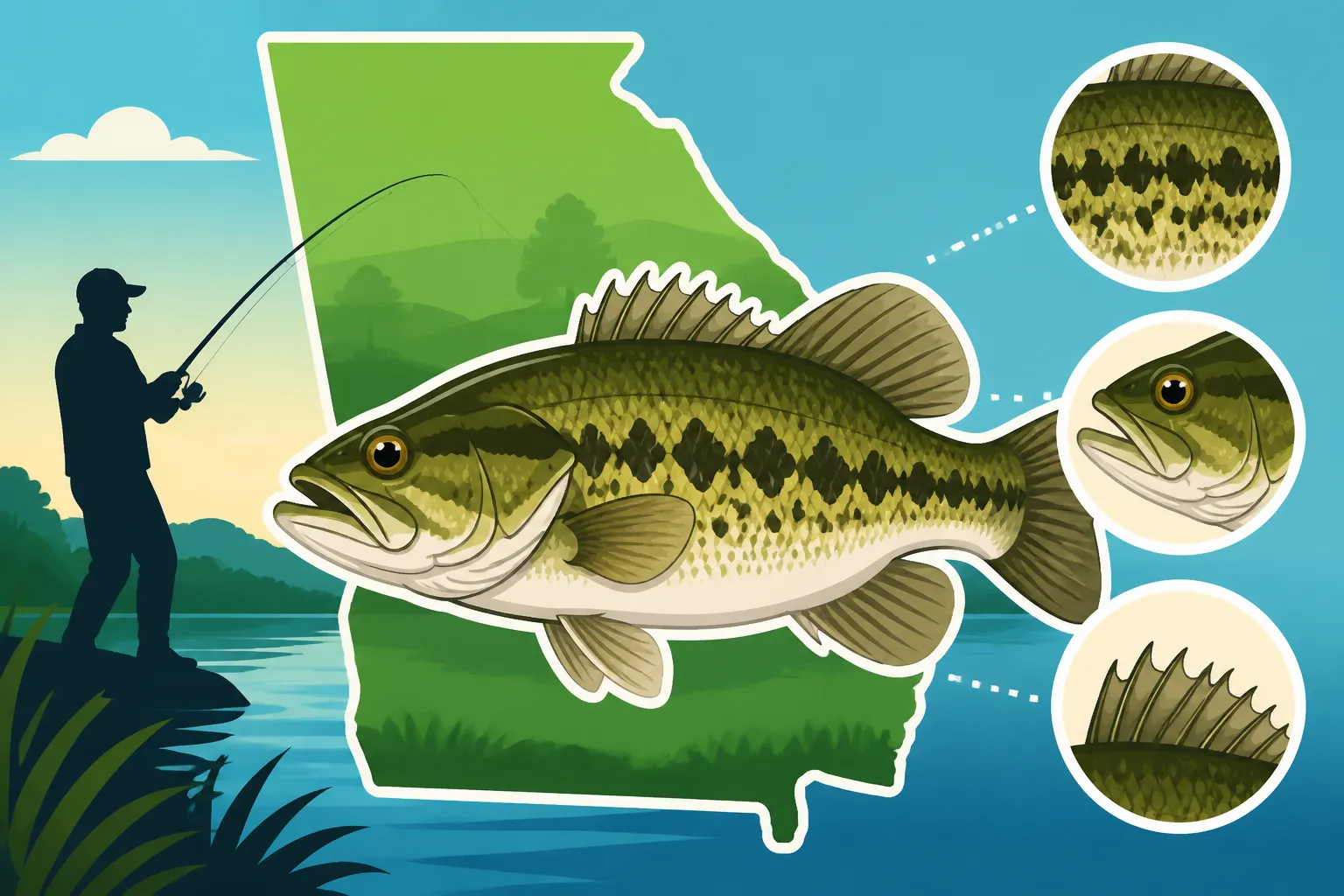
On a spotted bass, you'll often notice distinct rows of small, dark spots below the lateral line, usually forming parallel rows running horizontally along the fish's belly area. These spots are typically more defined and numerous than what you'd see on a largemouth. The lateral line itself can also appear more pronounced.
For a largemouth bass, the area below the lateral line is generally smoother, with less defined or scattered spots, if any. The overall impression is often a cleaner, more uniform white or light belly, without the prominent horizontal spotting of the spotted bass. While not as foolproof as the jawline or tongue patch, observing these scale patterns can help solidify your identification, especially if you have a clear view of the fish. These small details, when pieced together, can paint a very clear picture of the species you're handling.
Dorsal Fin Connection
Pay close attention to the dorsal fin, the prominent fin on the fish's back. Both bass species have two dorsal fins – a spiny front dorsal and a softer-rayed rear dorsal. The key difference lies in how these two sections are connected.
On a spotted bass, the spiny and soft-rayed sections of the dorsal fin are typically connected by a noticeable, albeit shallow, dip. It's a continuous fin, but there's a clear, lower membrane where the two sections meet, creating a distinct notch.
For a largemouth bass, the two dorsal fins are often almost completely separated, or the connection is extremely deep, forming a much more pronounced notch or even appearing as two distinct fins. Sometimes, it looks like there's almost no membrane connecting the two sections at all. This difference can be a bit more subtle, but it's another piece of the puzzle to consider, especially when you're looking at multiple fish side-by-side or studying photos. When evaluating this feature, remember that the degree of separation can vary slightly within a species, so it's usually best to use this in conjunction with the jawline and tongue patch tests.
Spotted Bass vs. Largemouth Bass: A Detailed Comparison
To truly master the art of identification, it helps to put all these characteristics side-by-side. The differences, while sometimes subtle individually, create a very distinct overall profile when considered together.
Practical Identification Scenarios
Let’s imagine you're fishing on Lake Allatoona, a popular spot in North Georgia where both largemouth and spotted bass thrive. You cast your lure near some submerged timber and hook into a strong fighting fish. As you bring it to the boat, you notice its dark green back and prominent lateral blotches – could be either!
First, you look at the jaw. Does the corner of its mouth extend past its eye? If it clearly does, you've likely got a largemouth. If it stops under the eye, or just short of the back edge, it's leaning towards a spotted bass. Next, you carefully pry open its mouth and feel the tongue. Is it smooth? Largemouth. Is it rough with a gritty patch? Spotted bass. Finally, you might check the dorsal fin. A deep, almost separated notch points to largemouth, while a shallower, more continuous dip suggests a spotted bass. By running through this mental checklist, you can usually make a confident identification.
Sometimes, especially with smaller, juvenile fish, these features can be less pronounced. In those cases, a combination of clues becomes even more important. A young largemouth might have a less exaggerated jaw, for example. That's when checking for the tongue patch or the distinct horizontal rows of spots below the lateral line on a spotted bass becomes invaluable. The more criteria you can confirm, the higher your confidence in the identification. Remember, practice makes perfect, and the more bass you examine, the quicker and more accurate your assessment will become. Our guide on Largemouth Bass vs Spotted Bass: How to Tell Them Apart in Georgia provides even more practical comparisons.
Regional Differences in Georgia
It's also worth noting that regional factors can influence the appearance of bass, though the core identification features remain consistent. For example, a spotted bass from a clear, rocky North Georgia reservoir like Carters Lake might appear slightly lighter in coloration than one caught in the more stained waters of a river further south. This is largely due to camouflage, as fish adapt their color to their environment. However, these environmental variations won't change the fundamental structure of their jaw, the presence of a tongue patch, or their fin morphology.
Another thing to consider is the size of the fish. Spotted bass generally don't grow as large as largemouth bass in Georgia. While you might occasionally hear of a trophy spotted bass, a 5-pound spotted bass is considered a true giant, whereas a 5-pound largemouth is a respectable, but not uncommon, catch. This size difference can sometimes be a clue, but it should never be your primary identifier, especially for smaller fish. Our article Spotted Bass Size Compared to Largemouth Bass dives deeper into typical sizes. It's crucial to rely on the anatomical features rather than just a fish’s general appearance or size, which can be misleading. Always refer to your Georgia fishing guide, which you can often purchase as a paperback or e-book from retailers like Amazon, for the most accurate and up-to-date information specific to your fishing area.
Here's a quick comparison table to help you keep these key features straight:
| Feature | Spotted Bass | Largemouth Bass |
|---|---|---|
| Jawline | Does NOT extend past the back of the eye | Extends noticeably past the back of the eye |
| Tongue | Has a rough, gritty tooth patch | Smooth, no tooth patch |
| Lateral Spots | Distinct rows of spots below lateral line | Fewer or less defined spots below lateral line |
| Dorsal Fin | Spiny and soft fins connected by a shallow dip (notched) | Spiny and soft fins nearly separated (deep notch) |
| Body Shape | Slightly more robust, smaller overall size | More elongated, typically larger overall size |
Tips for On-the-Water Identification
When you're out on the water, excited after a hook-up, precise identification needs to be quick and efficient. You want to handle the fish as little as possible, especially if you plan to release it. With a little practice, these quick checks will become second nature.
Quick Check Methods for Anglers
The moment that bass hits the net or comes boatside, immediately look at the jawline. This is your fastest and most reliable indicator. Can you see the back of the jaw extending beyond the eye? Yes = Largemouth. No = Likely a spotted bass. If there’s still doubt, gently grab the fish by the lower lip (the "bass thumb" grip is perfect for this) and quickly feel the tongue. A smooth tongue confirms largemouth; a rough patch confirms spotted bass. These two checks combined are usually enough to make a confident call in seconds.
Many seasoned anglers even have a small, clear ruler or a measuring tape with them that they can quickly hold up to the fish’s mouth to visually confirm the jawline. You can find these handy tools at any sporting goods store or even a general online retailer like Amazon. Developing this routine will not only make you a more informed angler but also more efficient, allowing you to get the fish back in the water faster, minimizing stress on your catch. Remember, especially if you're fishing in waters with varying Georgia Fishing Regulations Explained for different bass species, being able to identify your catch swiftly and accurately is paramount.
When in Doubt: Document and Release
Sometimes, despite your best efforts, you might encounter a fish that just doesn't quite fit the mold, or perhaps you're fishing in low light conditions where it's hard to be certain. In these situations, the best practice is to err on the side of caution. If you're unsure whether it's a largemouth or a spotted bass, and particularly if there are different size or creel limits for the species in that specific water body, it is always recommended to release the fish.
Consider snapping a quick photo of the fish, focusing on the jawline, tongue (if you can get a clear shot), and overall body shape. Later, you can review the photo or even consult with more experienced anglers or online forums to get a definitive identification. This way, you learn from the experience without potentially violating any regulations. Releasing an unidentified fish ensures you're protecting our fisheries and staying within the bounds of the law. You can read more about responsible fishing in our Basic Fishing Techniques Every Beginner Should Know article. It's a small act of conservation that goes a long way in maintaining healthy fish populations in Georgia's beautiful lakes and rivers.
Disclaimer
This article is for general informational purposes only and does not constitute professional advice. Laws, prices and regulations vary by location and change over time. Consult a qualified professional for guidance on your specific situation.