How to Fish a Swim Jig for Bass
You've been out on the water, throwing crankbaits, spinnerbaits, even topwater lures, but sometimes those stubborn Georgia bass just aren't biting the way you expect. It's frustrating when you know the fish are there, but they're tight-lipped or buried deep in cover. That's where the swim jig comes in – a stealthy, versatile weapon that can unlock bites when other presentations fail. This guide is all about demystifying the swim jig, helping you understand its nuances, rig it correctly, and fish it effectively for more bass in our beautiful Georgia waters.
Understanding the Swim Jig: More Than Just a Jig
The swim jig often gets overlooked, but it's a true workhorse in a bass angler's tackle box, especially here in Georgia where we have so much varied cover. It’s not just a jig you bounce on the bottom; it’s designed to be retrieved through the water column, mimicking baitfish or crawfish.
What Makes a Swim Jig Unique for Bass?
Think about a traditional jig: heavy head, often with a weed guard, designed to penetrate cover and sit on the bottom. Now, imagine a sleeker, more hydrodynamic version built to glide and undulate. That's a swim jig.
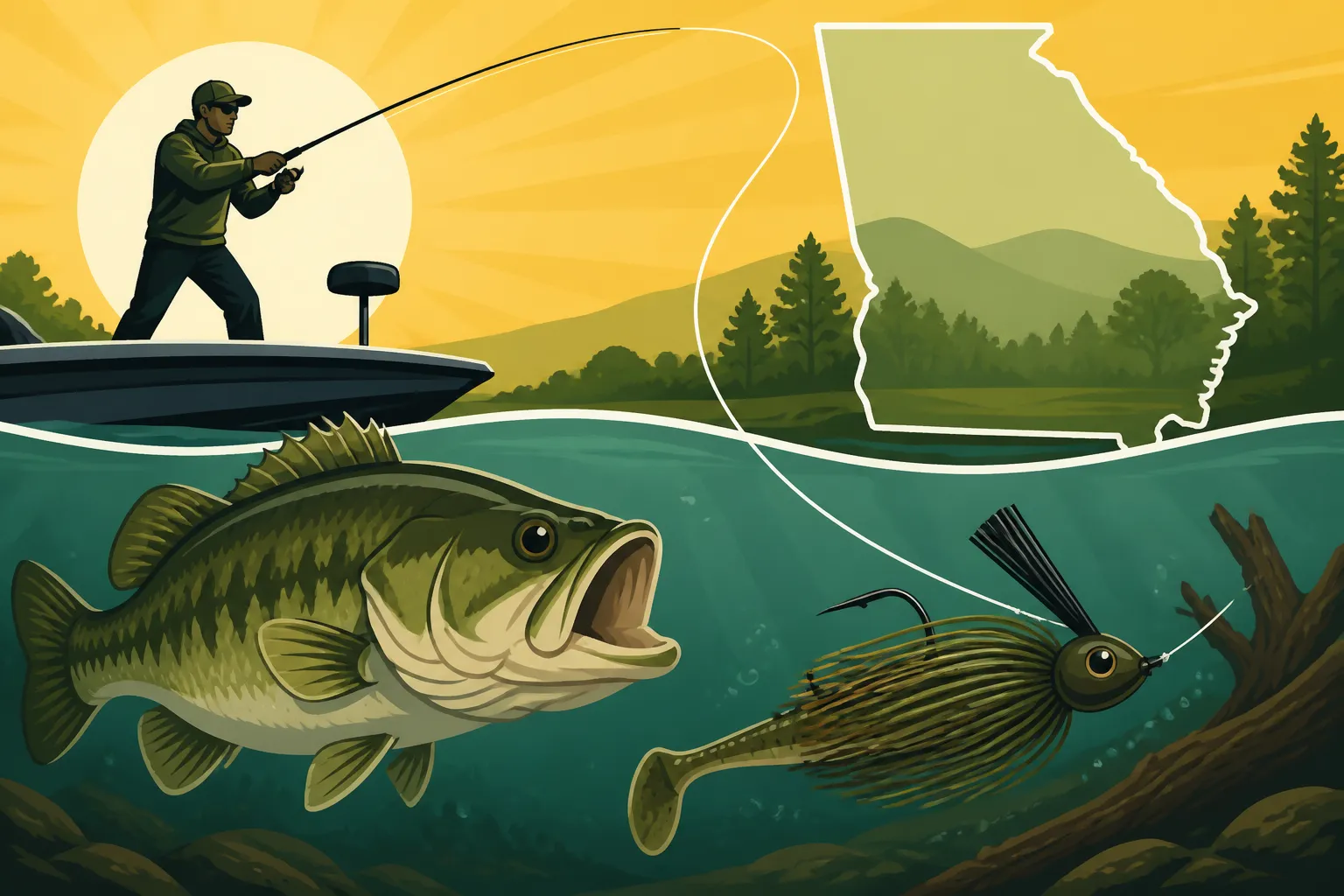
First off, the head shape is usually more pointed or bullet-shaped, allowing it to slip through grass, reeds, and submerged timber with minimal snagging. Unlike a spinnerbait that has exposed blades, the swim jig keeps its profile compact, making it incredibly weedless. Most come with a fiber weed guard, which is essential for working through dense cover. The skirt itself is often tied in a way that gives it a pulsating, lifelike action in the water, even on a steady retrieve. This subtle movement is key to enticing wary bass that might shy away from flashier baits. The hook is typically stout and sharp, designed for strong hooksets through thick bass jaws, and often positioned to ride upward, further enhancing its weedless properties. When you're fishing in places like Lake Lanier or Lake Oconee, where there's plenty of brush and docks, this weedless design is a game-changer. It means less time retrieving snags and more time actually fishing!
The Ideal Conditions for a Swim Jig
So, when should you reach for a swim jig? Honestly, it's one of those baits you can throw year-round, but it truly excels in certain situations. It shines in areas with abundant shallow to mid-depth cover, especially around emergent vegetation like hydrilla, lily pads, or cattails. Think about springtime, when bass are moving shallow for the spawn and hiding in flooded bushes or new grass growth. A swim jig can be presented quietly and precisely into these areas.
It's also fantastic for targeting docks, laydowns, and sparse wood cover. The ability to skip it under docks or along pontoon boats, thanks to its compact profile and weed guard, allows you to get into places other baits can't reach. The water clarity can also dictate its effectiveness; while it works in stained water, a swim jig really comes alive in slightly murky to moderately clear water where bass can track its subtle action and profile. Overcast days or low-light conditions (dawn and dusk) are also prime times, as the bass are more willing to roam and chase baitfish near cover. If you find yourself fishing a lake like Lake Hartwell or West Point Lake with lots of standing timber or grass lines, a swim jig should absolutely be on your rod.
Rigging Up for Success: Rods, Reels, Lines, and Trailers
Getting your gear dialed in is crucial for maximizing the swim jig's potential. It’s not just about tying it on; it’s about creating a balanced system that allows for accurate casting, powerful hooksets, and effective retrieves.
Choosing the Right Rod and Reel Combo
For swim jig fishing, you need a rod that offers a good balance of power and sensitivity. A medium-heavy to heavy power casting rod, typically between 7' and 7'6" in length, is ideal. This length provides excellent casting distance and leverage for pulling big bass out of heavy cover. The action should be fast to extra-fast, meaning the rod bends mostly in the top third, giving you the backbone needed for a solid hookset. You don't want a "noodle" rod; you need something that can quickly drive that stout hook home. Many anglers find that a 7'3" medium-heavy rod with a fast action is a fantastic all-around choice for a variety of jig weights and cover types. You can find excellent options on Amazon, from brands like St. Croix to Abu Garcia, that fit this description.
Pair this with a baitcasting reel that has a gear ratio in the 7.1:1 to 8.3:1 range. A faster retrieve ratio is important because it allows you to quickly pick up slack line, keep the jig moving, and react instantly to bites. Bass often hit a swim jig as it’s moving, and a high-speed reel helps you keep pace with them and quickly get them out of dense vegetation once hooked. The faster reel also allows you to cover water more efficiently, which is key when you're searching for active fish in large areas.
Line Selection for Swim Jigs
Your choice of fishing line is critical and often depends on the type of cover you're fishing.
- Braided Line: For heavy cover – think thick hydrilla, dense lily pads, or submerged brush piles – braided line is king. Its zero stretch means incredible sensitivity, allowing you to feel the most subtle bites, and its immense strength gives you the power to rip jigs free from weeds and pull big bass out of gnarly stuff. I usually opt for 40-65 lb test braid. The downside? Braid can be more visible in clear water, and its lack of stretch means less forgiveness during a violent head shake, sometimes leading to pulled hooks if your drag isn't set perfectly. However, for fishing places like Lake Seminole with its notorious grass beds, braid is non-negotiable.
- Fluorocarbon Line: If you're fishing in more open water, around sparse cover, or in clearer conditions, 15-20 lb test fluorocarbon is a great choice. It's nearly invisible underwater, offers good abrasion resistance, and provides a decent amount of sensitivity. It has less stretch than monofilament but more than braid, giving you a bit of cushion when fighting fish.
- Monofilament Line: While less common for swim jigs due to its stretch and lower abrasion resistance, some anglers prefer 17-20 lb test monofilament for specific situations, particularly around docks or wood where the added stretch can prevent hooks from tearing out during short, powerful runs.
Many Georgia anglers will have two swim jig setups: one with braid for the nastiest stuff and another with fluorocarbon for cleaner, clearer water applications. This versatility ensures you're always prepared for the conditions.
Pairing the Perfect Trailer
The trailer is what gives your swim jig its irresistible action and bulk, mimicking whatever forage the bass are keying in on. Choosing the right one is almost as important as the jig itself.
- Paddle-tail Swimbaits: These are arguably the most popular swim jig trailers. They perfectly emulate baitfish like shad or bluegill, with the paddle tail providing a strong thumping action that bass can feel from a distance. Brands like Keitech Swing Impact FAT or Zoom Swimmin' Super Fluke are perennial favorites. Match the color of your swimbait to your jig for a cohesive presentation. If your jig is green pumpkin, a green pumpkin swimbait or one with some chartreuse will look natural. These are fantastic for a steady retrieve, especially when bass are chasing baitfish in open water or along grass edges.
- Crawfish Imitations: When bass are feeding on crawfish, especially in rocky areas or around wood, a small craw trailer can be deadly. The claws will flap and pulsate as you retrieve the jig, making it look like a fleeing craw. Look for compact craws like the Berkley PowerBait Chigger Craw.
- Grubs and Fluke-style Baits: Single-tail grubs offer a more subtle action, while fluke-style baits can provide a gliding, darting motion. These are great when you want a less aggressive presentation or in clearer water where bass might be more scrutinizing.
- Creature Baits: Sometimes, a chunky creature bait trailer can add bulk and a unique profile, making your swim jig look like a hybrid of prey items. The trick is to ensure the creature bait doesn't hinder the jig's weedless properties too much.
When selecting a trailer, consider the size of your jig, the size of the forage, and the desired action. A smaller jig might get a smaller swimbait, while a larger jig might handle a bulkier craw. Don't be afraid to experiment! You can usually find a great selection of jig trailers on Amazon to suit any condition.
| Swim Jig Weight (oz) | Recommended Trailer Type | Ideal Depth Range (feet) | Best Cover Type |
|---|---|---|---|
| 1/4 | Small Swimbait (2.5-3") | 1-5 | Sparse Grass, Docks, Open Water |
| 3/8 | Medium Swimbait (3-3.5"), Small Craw | 3-10 | Medium Grass, Laydowns, Docks |
| 1/2 | Large Swimbait (3.5-4"), Medium Craw | 5-15 | Heavy Grass, Submerged Timber, Brush Piles |
| 3/4 | Large Swimbait (4"), Bulkier Craw | 10-20 | Deep Grass, Thick Brush, Strong Current |
Mastering the Retrieve: Techniques for Every Scenario
The beauty of the swim jig is its versatility in retrieve. It’s not a one-trick pony; mastering different presentations will significantly increase your success.
The Standard Swim: Steady Retrieve and Pauses
The most common and often most effective way to fish a swim jig is with a steady retrieve, much like you would a spinnerbait or a shallow-running crankbait. Cast your jig out, let it sink to your desired depth (usually just above the cover you’re targeting), and begin a slow to moderate retrieve. The goal is to keep the jig moving consistently, allowing the trailer to provide all the action.
The speed of your retrieve will depend on several factors: water temperature, bass activity, and the desired depth. In colder water or when bass are sluggish, a slower retrieve is often better. In warmer water or when fish are aggressive, you can speed it up. Pay attention to how the jig feels through the water – you want to feel the subtle thump of the paddle tail or the pulse of the craw. Vary your retrieve with occasional pauses or slight twitches of the rod tip. Often, a bass will strike right as the jig falls or changes direction after a pause. This technique is fantastic for covering water along grass lines, across flats, or around scattered cover. Don't forget to check out articles like Best Retrieve Speed for a Crankbait as some of the principles of consistent retrieve can carry over.
Flipping and Pitching the Swim Jig
When bass are buried deep in thick cover – think matted grass, flooded bushes, or dense wood – the swim jig transforms into a finesse punching bait. Flipping and pitching allow for quiet, precise presentations into tight spots. Use a heavier jig (½ oz or ¾ oz) for this, with a compact craw or creature bait trailer, and definitely a braided line.
Once you’ve accurately pitched or flipped your jig into the cover, let it fall through. Many bites will occur on the initial fall. If no bite, you can subtly shake the rod tip to make the jig dance, then slowly retrieve it out of the cover, letting it "swim" through any open pockets. This method is incredibly effective in places like the dense shallow cover found on the upper Chattahoochee River during high water periods or around the heavy vegetation in some of Georgia's Public Fishing Areas. The weedless nature of the swim jig really shines here, allowing you to penetrate cover that would snag other baits.
Working It Through Grass and Cover
This is where the swim jig truly excels. Its sleek head design and weed guard make it a master at navigating dense vegetation and other snags.
When retrieving through grass, keep your rod tip high and maintain a steady retrieve. If you feel the jig pick up a piece of grass, a quick, sharp snap of the rod tip will usually clear it without interrupting the jig's action too much. Don't stop your retrieve; keep it moving! The weed guard is designed to deflect snags, so trust it.
For submerged timber or brush piles, try to "read" the cover. Visualize how the jig will move through it. You can bump the jig off branches, letting it fall slightly after contact, which often triggers a reaction strike. Similarly, when fishing docks, skip the jig as far under the structure as possible, then retrieve it back along the pilings or crossbeams. The key is to keep the jig in the strike zone, near the cover, for as long as possible. Understanding How to Catch Bass Around Submerged Timber is a skill that transfers beautifully to swim jig fishing.
Seasonal Strategies and Georgia Hotspots for Swim Jigs
Knowing when and where to throw a swim jig in Georgia's diverse fisheries will give you a significant edge. Our state offers a fantastic variety of environments, each with its own rhythm and seasonal patterns.
Spring and Summer Swim Jig Tactics
Spring: This is prime time for swim jigs in Georgia. As water temperatures rise, bass move shallow to spawn, congregating around emergent vegetation, flooded bushes, and shallow docks. A swim jig, especially in green pumpkin, black and blue, or natural shad patterns, is deadly during the pre-spawn and spawn phases. Target shallow coves, creek arms, and areas with new grass growth. A slow, steady retrieve over submerged grass or through sparse cover is often all it takes. During the post-spawn, bass are recovering and often guard fry, making them aggressive towards anything that looks like a threat to their young, so a swim jig can draw ferocious strikes. For more on this, check out Spring Bass Fishing Patterns on Georgia's Reservoirs.
Summer: As the scorching Georgia summer arrives, bass often retreat to deeper, cooler water or seek refuge in dense overhead cover. The swim jig remains effective, but your tactics will need to adapt. Focus on early mornings, late evenings, or overcast days when bass are more active in shallower water. During bright midday conditions, target shady areas under docks, overhanging trees, or thick mats of vegetation. Skipping a swim jig deep under docks or punching it through matted hydrilla can be incredibly productive. A slightly faster retrieve might be necessary to entice active summer bass. Consider colors that mimic bluegill or shad, depending on the predominant forage.
Fall and Winter Considerations
Fall: Autumn in Georgia brings falling water temperatures and aggressive feeding as bass prepare for winter. The swim jig continues to shine, particularly around dying grass lines and brush piles. Bass will often move to transitional areas, following baitfish that are migrating out of shallow coves. A medium-speed retrieve along these grass edges or through scattered cover can be very effective. As grass begins to die off, the remaining clumps become ambush points. The swim jig’s weedless nature makes it perfect for probing these isolated pockets of cover. Explore Fall Bass Fishing Patterns on Georgia's Lakes for more insights.
Winter: While many anglers put away their swim jigs in winter, it can still be a secret weapon on warmer, sunny days, particularly in stained water. Bass activity slows down, so a much slower, almost dragging retrieve is necessary. Target deeper cover like submerged timber or rocky ledges, where bass might be hunkered down. On those occasional warm winter afternoons, bass might move up onto sun-soaked banks with sparse cover, offering a brief window for a swim jig bite. Matching your trailer to a slow-moving crawfish or a lethargic baitfish can be crucial during this period. Understanding How to Choose Lures for Cold Water will help you fine-tune your approach.
Top Georgia Lakes and Rivers for Swim Jigging Bass
Georgia is blessed with incredible bass fisheries, and many of them are perfect for swim jigging.
- Lake Lanier: While famous for its spotted bass, the largemouth population also thrives, especially in the abundant dock cover and pockets of hydrilla. Skipping a swim jig under docks is a deadly technique here. Read up on Best Spots for Bass Fishing on Lake Lanier to pinpoint prime swim jig territory.
- Lake Oconee & Lake Sinclair: These sister lakes are renowned for their robust bass populations, featuring ample grass, brush piles, and shallow wood. The stained to clear water provides excellent conditions for swim jigs, particularly around boat docks and lily pads in creek arms.
- Lake Seminole: Known for its vast expanses of hydrilla, milfoil, and cypress trees, Lake Seminole is a swim jig paradise. Punching heavier swim jigs through mats or swimming lighter ones along grass edges can yield monster bass.
- West Point Lake: With its fluctuating water levels and abundant timber, West Point offers fantastic opportunities for swimming jigs through standing trees and flooded bushes.
- Flint River: For a riverine experience, the Flint River offers great shoal bass and largemouth fishing, especially around rocky shoals and woody cover where a swim jig can mimic baitfish or crawfish navigating the current.
No matter where you choose to fish in Georgia, remember that the swim jig is a versatile and effective tool. It allows you to present a lifelike, weedless offering into places other baits simply can't reach, often triggering strikes from bass that have seen every other lure in the book. Don't be afraid to experiment with colors, weights, and retrieves – the more you fish it, the more confident you'll become, and the more bass you'll catch!
Disclaimer
The information provided in this guide is for general informational purposes only. Fishing regulations, license requirements, and local conditions can change frequently. Always consult the latest Georgia Department of Natural Resources (DNR) guidelines and local authorities before fishing. Fishing inherently involves risks, and safety precautions should always be observed.