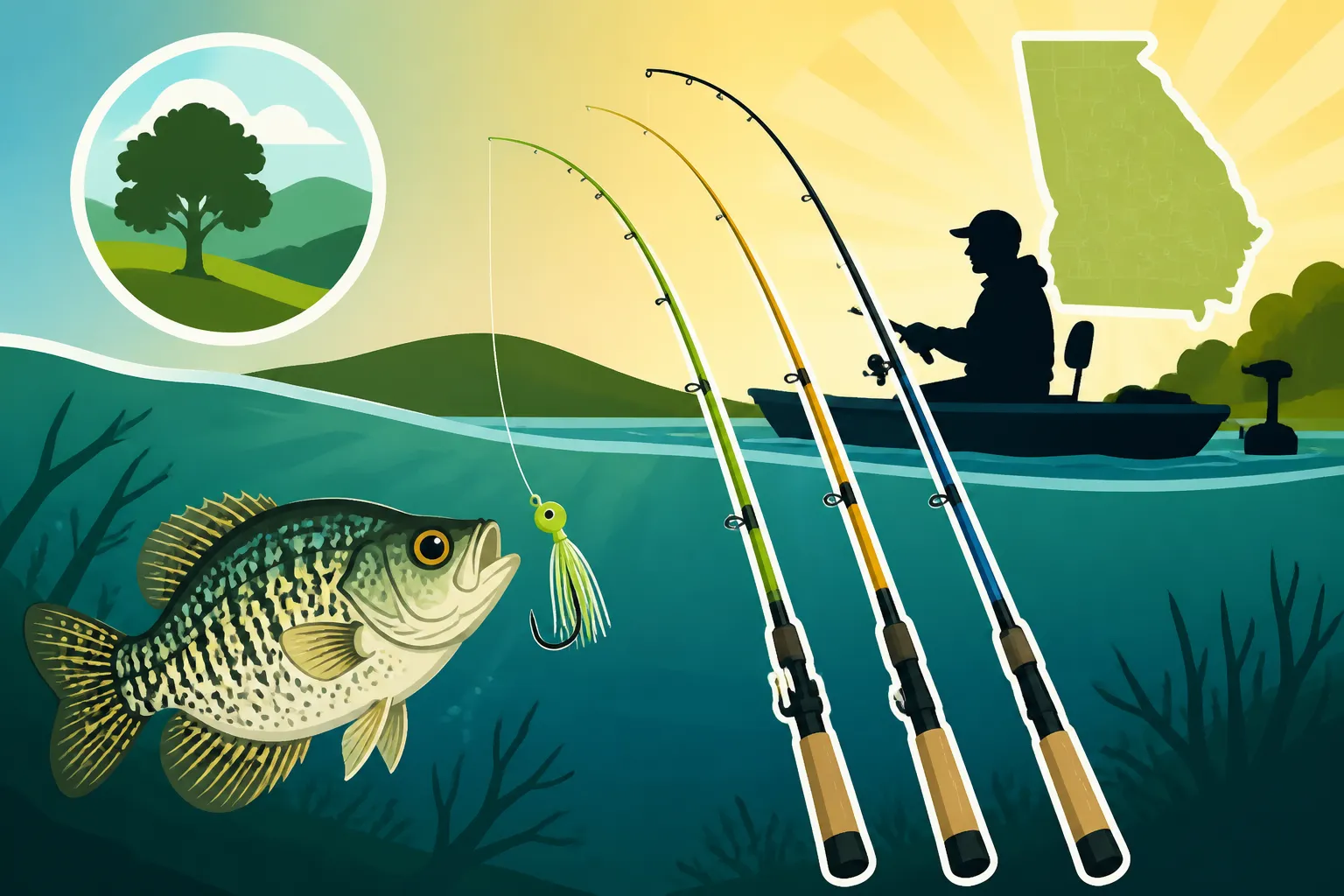
Best Rod Length for Crappie Jigging
If you've ever spent a frustrating day crappie fishing, feeling like your rod just isn't quite right – maybe it's too long for that tight dock shot, or too short for reaching those brush piles – you know the struggle is real. Picking the perfect rod length for crappie jigging can feel like a guessing game, but it makes a huge difference in your success and enjoyment on the water. This guide is here to untangle the confusion, helping you understand how rod length impacts your jigging, and what to look for based on your fishing style and the conditions you face.
The Crucial Role of Rod Length in Crappie Jigging
When it comes to crappie jigging, your rod isn't just a stick to hold your line; it's a finely tuned instrument that dictates casting distance, accuracy, sensitivity, and how you present your jig. Many anglers overlook rod length, often grabbing whatever panfish rod they have, but this single factor can profoundly affect your ability to detect those subtle crappie bites and efficiently work your lure. It's about finding that sweet spot that gives you the best control and feedback for the specific way you're trying to catch those tasty papermouths.
Imagine trying to thread a needle with a broom handle versus a sewing needle – that's the kind of difference the right rod length can make in your crappie game. Different lengths are optimized for different situations, from open-water casting to precise vertical jigging in tight cover. Understanding this fundamental concept is the first step toward becoming a more effective crappie angler.
Why Shorter Rods Excel for Precision and Close-Quarters Jigging
Shorter rods, typically in the 4-foot to 5-foot range, are absolute workhorses when precision and maneuverability are your top priorities. Think about those times you're fishing under docks, around fallen trees, or in dense lily pads – places where long casts aren't needed, but accuracy is everything. A shorter rod allows for tighter, more controlled casts, often referred to as "dock shooting" or "flipping," where you essentially shoot your jig like an arrow into incredibly small openings.
The shorter length also means less leverage for the fish to fight against, giving you more immediate control over smaller crappie, especially important when you're trying to keep them out of snaggy cover. They're lighter, too, which reduces arm fatigue during those long days of repetitive casting or when you're How to Jig for Crappie in a specific spot. If your crappie fishing involves a lot of close-quarters combat or targeting tight spots, a short rod is your best friend. Many seasoned anglers keep a couple of these specialized rods on hand for specific scenarios, often finding excellent options at local tackle shops or online retailers like Bass Pro Shops.
The Advantages of Longer Rods for Casting Distance and Vertical Jigging
On the flip side, longer rods – usually 6 feet and up, sometimes reaching 10-14 feet for specialized techniques – open up a whole new world of crappie fishing possibilities. These rods shine when you need to cover more water, make longer casts, or when you're employing vertical jigging strategies in deeper water. The increased length provides a longer arc for your cast, propelling lightweight crappie jigs much further than a shorter rod could. This is invaluable when crappie are scattered across open flats or holding off points where you need to reach them from a distance.
For vertical jigging, especially from a boat or kayak, a longer rod helps you keep your line directly under you, preventing the jig from swinging away in current or wind. It also gives you more line control and can help absorb the shock of a hooked fish, acting as a longer lever to steer the fish away from snags in open water. Spider rigging, a popular multi-rod technique for crappie, almost exclusively uses very long rods, often 10-16 feet, to spread out multiple lines and jigs over a wide area. When you're trying to reach those elusive crappie schooled in deep water or spread out wide, a longer rod is a must-have tool in your arsenal, and you can often find a good selection on Amazon.
Matching Rod Length to Your Crappie Jigging Technique
The "best" rod length isn't a one-size-fits-all answer; it's deeply tied to the specific crappie jigging technique you're using. From pinpoint accurate dock shooting to expansive spider rigging, each method benefits from a particular rod length to maximize its effectiveness. Understanding these correlations will help you select the right tool for the job, rather than forcing a technique with unsuitable gear.
Consider how you typically fish for crappie. Are you constantly moving, casting to different pieces of cover? Or do you prefer to sit over a school, dropping your jig straight down? Your preferred method, or the method most effective for your local Best Crappie Lakes in Georgia, should be the primary driver behind your rod length choice.
Dock Shooting and Skipping: Short and Sweet for Accuracy
Dock shooting and skipping are highly specialized techniques designed for getting jigs into tight, often otherwise inaccessible, spots under boat docks, overhanging trees, and thick cover. For these precise, short-distance maneuvers, a rod between 4 feet 6 inches and 5 feet 6 inches is typically ideal. The shorter length allows you to load the rod with minimal line, creating a "slingshot" effect that propels the jig low and fast across the water, making it skip under obstacles like a stone.
A rod in this length range gives you incredible control and accuracy for hitting those tiny windows. Imagine trying to skip a jig under a dock with a 7-foot rod; it's unwieldy and lacks the necessary flick. These rods are often paired with lightweight spinning reels and a relatively thin, sensitive line to enhance the delicate presentation. If you spend a lot of time targeting crappie hiding in structure, especially around marinas and boathouses, this short, powerful, yet sensitive rod is indispensable. You'll want a fast action tip on these rods for maximum responsiveness.
Vertical Jigging and Dropping: Versatility in the Mid-Range
When you're vertical jigging, whether it's over brush piles, submerged timber, or deep water humps, you're looking for a rod that offers a balance of sensitivity, backbone, and manageability. Rods in the 5-foot 6-inch to 7-foot range tend to be incredibly versatile for this style of fishing. This length provides enough leverage to fight fish and keep them out of cover, while still being sensitive enough to detect those often-subtle vertical bites.
For precise drops and staying directly above the fish, a 6-foot to 6-foot 6-inch rod is a common sweet spot. It allows you to present your jig with minimal line angle, which improves your feel for the jig and any bites. If you're fishing deep water and need to work a jig slowly, How to Jig for Crappie in Deep Water with a slightly longer rod in this range can help maintain better contact with your lure. These mid-length rods are also great for casting jigs a moderate distance when crappie are suspended off structure. They're truly the utility players of crappie fishing, capable of handling a wide array of situations.
Casting for Crappie: Maximizing Distance with Longer Rods
If your crappie fishing involves covering open water, casting to visible schools, or reaching distant submerged structures, you'll benefit greatly from longer rods, typically 6 feet 6 inches to 7 feet 6 inches. The increased length acts as a longer lever, allowing you to cast small, lightweight crappie jigs much further than you could with a shorter rod. This extra casting distance means you can cover more water efficiently, locate scattered schools of crappie, and approach skittish fish without spooking them.
Longer rods also provide better line control over long distances, helping you manage slack and set the hook effectively even when there's a lot of line out. When a crappie bites at the end of a long cast, the forgiving action of a longer rod can help absorb the initial shock, preventing the hook from tearing out of their delicate mouths. For bank anglers or those fishing from boats in expansive areas, a longer casting rod is paramount for reaching those productive spots that might be just out of reach with a shorter setup.
Spider Rigging and Trolling: Specialty Long Rods for Spread
Spider rigging and trolling for crappie are methods where you run multiple rods simultaneously, spreading them out from the boat to cover a wide swath of water. For these specialized techniques, extra-long rods – often ranging from 10 to 16 feet, or even longer – are not just beneficial, but essential. These rods are designed to keep multiple lines separated, preventing tangles and allowing each jig to work independently.
The sheer length allows you to position jigs at various distances and depths around your boat, effectively creating a "net" to intercept schools of crappie. When a fish bites, the long rod acts as a shock absorber, often allowing the crappie to hook itself with minimal input from the angler. These rods are typically very flexible, with a soft action that telegraphs even the lightest tap. While you might not find a 16-foot rod at every tackle shop, specialty stores like Bass Pro Shops or online platforms like Amazon will carry a variety of options for anglers looking to embrace this highly effective method.
Rod Action and Power: Beyond Just Length
While rod length is a critical factor, it works in tandem with rod action and power to define a rod's overall performance for crappie jigging. You can have two rods of the same length that feel completely different due to these attributes. Understanding how they interact will help you make an even more informed decision and truly optimize your crappie setup. Best Rods for Crappie Fishing in Georgia will often specify these details.
Understanding Rod Action: Fast, Moderate, and Slow
Rod action refers to where on the rod the bend occurs when pressure is applied.
- Fast Action: A fast action rod bends mostly in the tip section. This is fantastic for crappie jigging because it provides superior sensitivity, allowing you to feel even the most subtle tap from a crappie. The quick taper also translates to faster hook sets, crucial for those light-biting fish. For dock shooting, vertical jigging, and working jigs with subtle movements, a fast action tip is often preferred. It gives you the immediate feedback needed to detect tiny bites and react swiftly.
- Moderate Action: A moderate action rod bends from the tip down into the middle section. These rods offer a good balance of casting distance and sensitivity. They can be more forgiving for lighter lines and can prevent hooks from tearing out of a crappie's soft mouth, especially when a fish makes a sudden run. Many general-purpose crappie rods fall into this category, making them versatile for various jigging and casting scenarios.
- Slow Action: A slow action rod bends almost from the handle all the way through the tip. These are less common for traditional jigging but can be found in some specialized panfish rods for very light bait presentations or bobber fishing. They offer maximum flexibility but lack the sensitivity and quick hook-setting power often desired for active jigging.
For crappie jigging, particularly with small jigs, a fast or extra-fast action tip is generally preferred, as it maximizes sensitivity and allows for quick, responsive hook sets.
Decoding Rod Power: Light, Ultra-Light, and Medium-Light
Rod power (or "weight") refers to how much force it takes to bend the rod. It dictates the strength of the rod and the size of the line and lure it's designed to handle.
- Ultra-Light (UL): This is the bread and butter for most crappie jigging. Ultra-light rods are designed for incredibly small jigs (1/32 oz to 1/16 oz) and light lines (2-6 lb test). They offer unmatched sensitivity, allowing you to feel the slightest nibble. The drawback is less backbone, meaning you have to play larger fish more carefully. For targeting smaller crappie or when the bite is extremely light, UL is the way to go.
- Light (L): A step up from ultra-light, light power rods can handle slightly heavier jigs (1/16 oz to 1/8 oz) and lines (4-8 lb test). They offer a bit more power to steer fish away from cover but still maintain excellent sensitivity. This is a very popular choice for crappie fishing, especially when you might encounter slightly larger fish or need to cast a bit further.
- Medium-Light (ML): These rods are designed for even heavier jigs (1/8 oz to 1/4 oz) and lines (6-10 lb test). While they offer more power, they typically sacrifice some of the delicate sensitivity crucial for light crappie bites. A medium-light rod might be used if you're targeting truly large slab crappie, or if you're in an area with extremely dense cover and need to pull fish out quickly. However, for most crappie jigging, UL or L power rods are usually sufficient.
For crappie jigging, especially with those tiny jigs, an Ultra-Light or Light power rod with a Fast action tip is the golden combination. This pairing gives you the necessary sensitivity to detect the bite and the flexibility to properly present your small lures.
Putting Together Your Ideal Crappie Jigging Setup
Once you've zeroed in on the right rod length, action, and power, it's time to think about the other components of your setup. The reel, line, and even the jigs themselves all play a role in making your crappie jigging experience as effective and enjoyable as possible. A well-balanced setup feels like an extension of your arm, giving you complete control over your presentation.
Choosing the Right Reel to Complement Your Rod
For crappie jigging, especially with ultra-light rods and light lines, a small, lightweight spinning reel is almost always the best choice. Look for reels in the 500 to 1000 size range. These reels are designed to handle thin lines and balance perfectly with the delicate nature of crappie rods. A smooth drag system is paramount, as it protects your light line from breaking when a feisty crappie takes a run.
You want a reel that feels comfortable in your hand and doesn't add excessive weight, which would throw off the balance of your sensitive rod. A good quality reel will also have a smooth retrieve, minimizing line twist and allowing for precise jig control. Remember, crappie often have soft mouths, so a smooth, consistent drag is your best friend in preventing lost fish at the boat.
Line Selection: Sensitivity, Strength, and Stealth
Line choice is just as critical as your rod for crappie jigging. You need a line that offers a delicate balance of sensitivity, low visibility, and enough strength to handle crappie without being too heavy for your small jigs.
- Monofilament: Often a good choice for beginners due to its affordability and stretch, which can act as a shock absorber. However, its stretch also reduces sensitivity, making it harder to feel subtle bites. Stick to 2-4 lb test for crappie.
- Fluorocarbon: This line offers excellent sensitivity, low visibility (it's nearly invisible underwater), and good abrasion resistance. It has less stretch than mono, which translates to better feel. It's a fantastic choice for crappie jigging, especially when the water is clear or the fish are finicky. 2-6 lb test is common.
- Braided Line: Braided line offers superior sensitivity and incredible strength-to-diameter ratio with virtually no stretch. This means you feel everything. However, it is visible underwater, so many anglers will tie a fluorocarbon leader (3-5 feet) to their braid to maintain stealth. Braided line in 4-8 lb test (with a fluorocarbon leader) is an advanced setup that provides maximum feel for those incredibly light bites.
Ultimately, your line choice will depend on water clarity, cover, and personal preference, but remember that sensitivity is key for crappie, and you can't go wrong with Best Jig Colors for Crappie Fishing and a light fluorocarbon or braid-to-fluoro leader setup.
The Impact of Jig Weight and Size on Your Rod Choice
The size and weight of your crappie jigs directly influence the rod power and action you'll need. Crappie jigs typically range from incredibly small 1/64 oz up to 1/8 oz or even 1/4 oz for larger presentations.
- Lighter Jigs (1/64 oz – 1/32 oz): These tiny jigs require ultra-light rods with a fast, sensitive tip to cast them effectively and feel their subtle action. A rod that's too stiff will feel like you're casting a feather and won't load properly.
- Standard Jigs (1/32 oz – 1/16 oz): This is the most common range for crappie jigs, and they pair well with ultra-light or light power rods. The rod needs enough backbone to handle the jig's weight for casting and working, but still be sensitive enough for the bite.
- Heavier Jigs (1/8 oz – 1/4 oz): While less common for crappie, these heavier jigs might be used in deeper water, strong current, or for targeting larger fish. For these, a light to medium-light power rod might be more appropriate to handle the increased weight and cast accurately.
Always try to match your jig weight to the rod's specifications to get the best casting performance and sensitivity. An unbalanced setup will make fishing frustrating and less effective.
Scenario-Based Rod Length Recommendations for Crappie Jigging
To tie it all together, let's look at some common crappie fishing scenarios and the rod length that typically shines in each. This isn't a hard and fast rule, but rather a guideline to help you select the most effective tool for your specific situation.
| Scenario | Recommended Rod Length (Feet) | Key Advantages | Best Rod Power/Action |
|---|---|---|---|
| Dock Shooting/Skipping | 4'6" – 5'6" | Pinpoint accuracy, tight cover access, maneuverability | UL/L, Fast/Extra-Fast |
| Vertical Jigging (Boat) | 5'6" – 6'6" | Good line control, sensitivity, leverage in tight spots | UL/L, Fast |
| Vertical Jigging (Kayak) | 5'0" – 6'0" | Manageable in confined space, good line control | UL/L, Fast |
| Casting from Shore/Bank | 6'6" – 7'6" | Maximum casting distance, covering more water | L/ML, Moderate-Fast/Fast |
| Casting from Boat (Open) | 6'0" – 7'0" | Balanced distance and control, versatile | L/ML, Moderate-Fast/Fast |
| Spider Rigging/Trolling | 10'0" – 16'0"+ | Wide spread, multiple lines, auto-hooking | L, Moderate/Slow |
| Brush Pile Work | 5'9" – 6'9" | Reach into cover, control fish, sensitive | L, Fast |
Remember that these are general guidelines. Your personal comfort, height, and the specific characteristics of your chosen fishing spot will also influence your optimal rod length. Don't be afraid to experiment with different lengths to find what truly feels best for you and your fishing style. For some anglers, a single versatile rod around 6' to 6'6" will cover many bases, especially if they are primarily casting from a boat or bank, while others will have specialized setups for each technique.
When One Rod Isn't Enough: Building a Versatile Crappie Arsenal
For many dedicated crappie anglers, having just one rod simply won't cut it. The diverse range of crappie habitats and techniques often demands a small arsenal of specialized rods. For example, you might start your morning dock shooting with a 5-foot ultra-light, then switch to a 6-foot 6-inch light power rod to cast to submerged structure, and finally transition to a set of 12-foot rods for Trolling Gear for Georgia Striped Bass (or crappie in this case).
Building a versatile crappie arsenal allows you to adapt to changing conditions and target fish in the most effective way possible. You don't need to break the bank to do it either; many reputable brands offer excellent crappie rods at various price points. Keep an eye out for sales at outdoor retailers like Bass Pro Shops or explore the wide selection available online through Amazon. Having the right tool for each job will significantly increase your catch rates and overall enjoyment on the water, helping you bring home those delicious crappie fillets.
Disclaimer
This article is for general informational purposes only and does not constitute professional advice. Laws, prices and regulations vary by location and change over time. Consult a qualified professional for guidance on your specific situation.