Georgia Boat Title vs Registration, What’s the Difference
You've just bought a shiny new fishing boat, or perhaps you're finally taking the plunge on that used Jon boat you've been eyeing for years. Excitement is high, but then the paperwork looms: "Do I need a boat title? What about registration? Are they the same thing?" It's a common source of confusion for many Georgia anglers, and frankly, it can feel like navigating a maze of regulations. This guide is here to untangle the differences between a Georgia boat title and registration, explaining what each means for you as a boat owner and how to ensure you're fully compliant before hitting the water.
Understanding the Basics: What Are Boat Titles and Registrations?
It's easy to lump "boat title" and "boat registration" into one big, intimidating pile of bureaucracy, but they actually serve distinct and equally important purposes in Georgia. Think of it like owning a car: you have a title proving ownership, and you have a tag and registration allowing you to legally drive it on public roads. The same fundamental principle applies to your boat, even if the specifics feel a little different on the water.
What is a Boat Title?
A boat title in Georgia is essentially the official legal document that proves you are the owner of a particular vessel. It's like the deed to your house or the title to your car. This piece of paper confirms who has rightful ownership of the boat and any associated motor. It's issued by the Georgia Department of Natural Resources (DNR), Wildlife Resources Division. When you buy a boat, especially from a dealer, this is the document that gets transferred into your name, solidifying your legal claim to the vessel.
More than just proving ownership, a title plays a crucial role in financial matters. If you finance your boat purchase, the lender will often hold the title until the loan is paid off, protecting their investment. Without a clear title, selling your boat down the road can become a real headache, as buyers need assurance that you legally own what you're selling. It's the ultimate safeguard of your investment in your watercraft, ensuring there's a verifiable paper trail for all transactions.
What is Boat Registration?
Boat registration, on the other hand, is the state's way of giving you permission to operate your vessel on Georgia's public waterways. It's not about ownership, but about operational legality. When you register your boat, the state assigns it a unique registration number (usually starting with "GA" followed by four numbers and two letters), which you're required to display prominently on the bow of your boat. You'll also receive a registration decal that must be affixed to the hull.
Registration in Georgia is typically required annually, and it ensures that your boat is accounted for by the state. This helps in countless ways, from search and rescue operations knowing which boats are where, to enforcing boating safety laws and regulations. It's how the state keeps tabs on the vessels using its lakes, rivers, and coastal waters, ensuring a safer and more organized environment for everyone. Think of it as your boat's driver's license and license plate all rolled into one.
Why Both Exist: The Dual Purpose
The reason Georgia (and most other states) requires both a title and registration boils down to distinct legal and practical needs. The title establishes a clear chain of ownership, protecting both buyers and sellers from fraud and providing security for lenders. It creates a definitive record of who owns the boat, much like a property record.
The registration, however, is about controlling and monitoring the use of the vessel on public waters. It ensures that boats are properly identified, that owners are aware of safety regulations, and that the state can effectively manage its waterways. Imagine the chaos if there were thousands of boats on Lake Lanier or the Altamaha River with no identifying marks or no record of who they belonged to. Both documents work together to create a comprehensive system that benefits boaters and the state alike, though it can feel like a lot to keep track of! For more details, check out our guide on Georgia Boat Registration Requirements Explained.
When Do You Need a Title vs. Registration in Georgia?
This is where the rubber meets the road, or rather, where the hull meets the water! Understanding which boats require a title versus just registration can save you a lot of grief. Georgia has specific rules, and not every watercraft falls under the same umbrella of requirements.
Boats That Require Titling
In Georgia, all mechanically propelled vessels, regardless of length, typically require a title. This means if your boat has any kind of motor – whether it's an outboard, an inboard, or even a small electric trolling motor – it needs to be titled. This includes everything from fishing boats for chasing bass on Lake Oconee, to ski boats, cruisers, and even pontoon boats for lazy days on the water. Larger sailboats over 12 feet in length also generally fall into the titling category, even without a motor, as they are considered significant investments.
This requirement helps track ownership of these more substantial vessels, especially given their value and the potential for financing. When you buy a new boat from a dealer like Bass Pro Shops, they'll typically handle the initial titling paperwork for you, simplifying the process. If you're buying a used boat, however, you'll need to make sure the seller provides a properly endorsed title, which you then transfer into your name. Failing to do so can lead to major headaches down the road.
Boats That Are Exempt from Titling
Now for the good news for some water enthusiasts! Not every vessel needs a title in Georgia. The primary exemptions generally include:
- Non-motorized vessels less than 12 feet in length: This category often includes many kayaks, canoes, paddleboards, and rowboats that rely solely on human power.
- Vessels without any mechanical propulsion: Even if they are longer than 12 feet, if they are strictly sail-powered (and under a certain length or type, though generally larger sailboats are titled) or human-powered, they might be exempt from titling.
- Boats documented with the U.S. Coast Guard: These are usually larger commercial vessels or yachts, and they follow federal documentation rules instead of state titling.
It’s crucial to understand that even if a vessel is exempt from titling, it might still require registration if it's mechanically propelled or falls into certain size categories. For instance, a 14-foot fishing kayak with a small electric trolling motor would need to be both titled and registered, even though a 10-foot paddle-powered kayak would need neither. Always double-check the current Georgia DNR regulations, especially if your vessel has any kind of motor. You can find more specific details in our article on Is a Canoe Exempt From Registration in Georgia?.
Universal Registration Requirements
Here's the simpler side of the coin: almost all mechanically propelled vessels that operate on Georgia's public waters must be registered. This is a pretty straightforward rule to remember. If it has an engine – any engine, no matter how small – you need to register it. This applies whether it's a bass boat, a pontoon, a sailboat with an auxiliary motor, or even a small canoe with an electric trolling motor clamped on the back.
The registration requirement applies universally to residents and non-residents alike, though non-residents might have different fees or temporary options. Once registered, your boat will get its unique "GA" numbers and a current decal. This decal acts as your proof that your annual registration fees have been paid and that your vessel is authorized for use. Even if your boat doesn't need a title, if it's got a motor, it almost certainly needs current registration. If you're unsure, it's always best to assume you need to register and verify with the DNR, rather than risking a fine. You'll want to avoid the Penalties for Fishing Without a License in Georgia or boat registration.
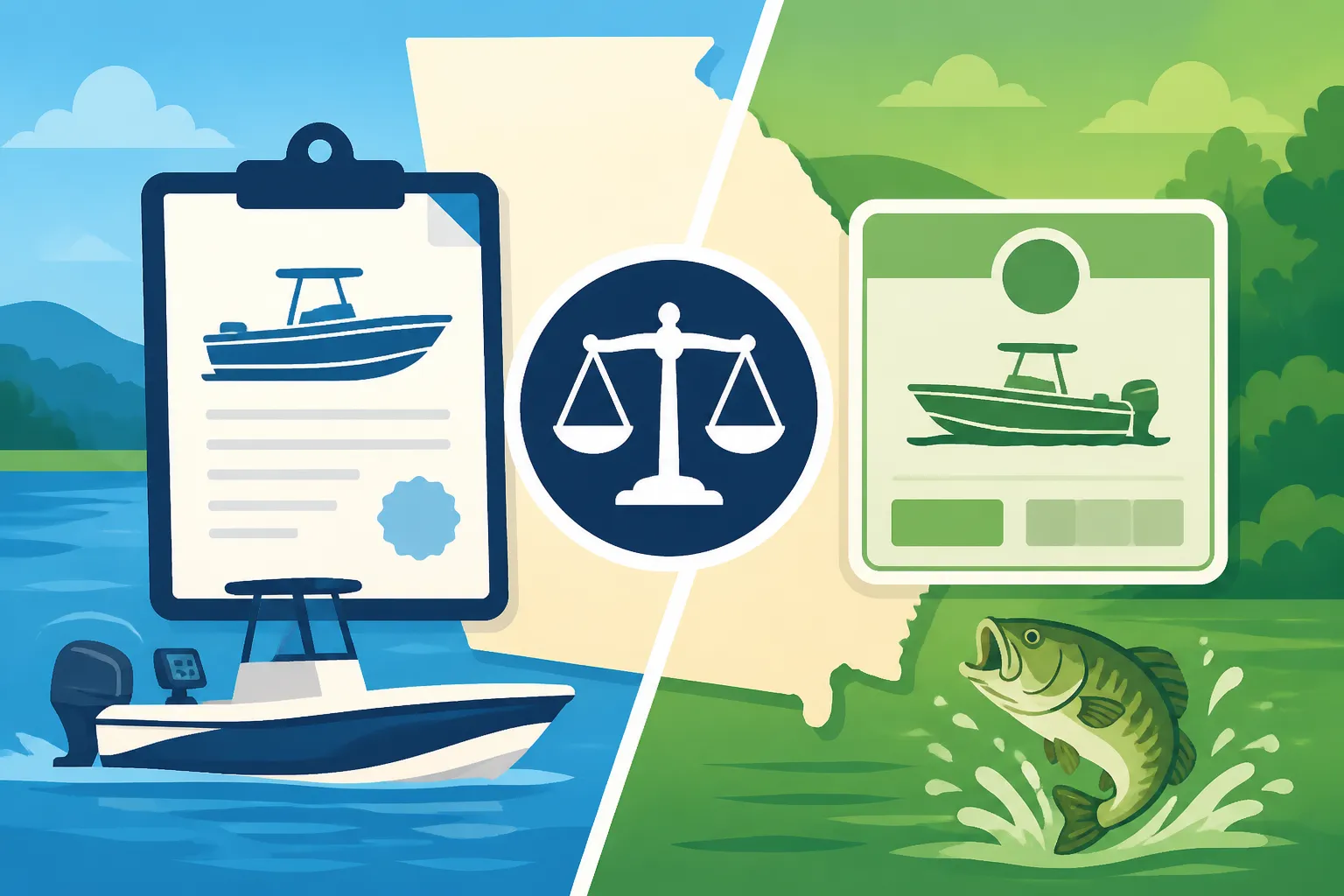
To help clarify, here's a quick comparison of titles versus registrations:
| Feature | Boat Title | Boat Registration |
|---|---|---|
| Purpose | Proves legal ownership | Grants permission to operate on public waterways |
| Issued By | Georgia DNR (Wildlife Resources Division) | Georgia DNR (Wildlife Resources Division) |
| When Needed | Most mechanically propelled vessels; sailboats > 12 ft | Almost all mechanically propelled vessels |
| Duration | Permanent (until transferred) | Typically annual (requires renewal) |
| Display | Kept securely by owner | GA numbers on bow, decal on hull |
| Financial | Often required for loans/sales | Primarily for state identification & regulation |
| Key Role | Proof of property ownership | Proof of legal operation |
The Process: How to Obtain a Title and Registration in Georgia
Now that you understand the "why" and "when," let's talk about the "how." The process for obtaining a boat title and registration in Georgia, while sometimes combined, has distinct steps depending on whether your boat is new or used. Don't worry, it's not as daunting as it sounds, especially with a clear plan.
Titling a New Boat
When you purchase a brand-new boat from a dealer, whether it's a local shop or a big retailer like Bass Pro Shops, they're typically set up to handle much of the initial titling paperwork for you. This is a huge convenience! What you'll receive from the dealer is a Manufacturer's Statement of Origin (MSO) or Manufacturer's Certificate of Origin (MCO). This document is like the boat's birth certificate and proves it's never been titled before.
You'll then submit this MSO/MCO, along with a bill of sale, to the Georgia DNR to apply for your official title. The application form for both title and registration is usually the same. Be prepared to provide personal identification and pay any applicable fees. The DNR will then process your application, issue your unique GA registration numbers and decal, and mail you the official title certificate. It's usually a fairly smooth process when buying new, as the dealer ensures all the initial documentation is correct.
Titling a Used Boat
Titling a used boat requires a bit more diligence on your part, as you're responsible for ensuring a proper transfer of ownership. When buying a used boat in Georgia, you absolutely must receive the original, properly endorsed title from the seller. "Properly endorsed" means the seller has signed off on their portion of the title, transferring ownership to you. Without this, you cannot legally obtain a new title in your name.
You'll take this endorsed title, along with a bill of sale (it's always wise to have one, even if not strictly required by DNR for title transfer in all cases), to the Georgia DNR. You'll fill out the application to transfer the title into your name and register the boat. This is also where you'd pay any sales tax that might be due. If the boat has never been titled (e.g., it was an older boat not previously subject to titling laws), you might need additional documentation like a sworn affidavit of ownership. Always verify what documents you need to Transferring a Boat Title After Buying Used in Georgia.
Registering Your Boat
Once your boat is titled (or if it's one of the rare exceptions that only needs registration), you'll proceed with the registration step. As mentioned, the application for title and initial registration are often combined. You can typically register your boat in several ways:
- Online: This is often the quickest and most convenient method, available through the Georgia DNR's online licensing and registration system. You can easily manage your account, renew your registration, and even print temporary documents.
- By Mail: You can download the necessary forms from the Georgia DNR website, fill them out, and mail them in with your payment and supporting documents.
- In Person: Many county tag offices or authorized license agents across Georgia can assist with boat registration. This can be a good option if you have questions or need immediate assistance, though not all locations handle titling.
Remember that registration needs to be renewed regularly (usually annually). The DNR will send you a reminder, but it's ultimately your responsibility to keep it current. You'll receive a new decal each year to show your registration is up-to-date. If you're ever wondering, "Is a Georgia fishing license good for 365 days?" or how long your boat registration lasts, it's important to know that most annual registrations in Georgia are valid for a calendar year, typically expiring on December 31st, regardless of when you purchased it within that year. Our guide on Georgia Boat Registration Renewal Guide has more details.
Common Pitfalls and Important Considerations for Georgia Boaters
Even with a good understanding of the basics, there are still a few areas where boaters commonly stumble. Being proactive and informed can save you a lot of hassle and potential fines down the line.
Keeping Your Records Current
Life happens. You move, you get a new phone number, or maybe you misplace important documents. It's critical to keep your boat title and registration records up-to-date with the Georgia DNR. If you move, update your address promptly so you don't miss renewal notices or important communications. Losing a title can be a major headache, especially if you plan to sell the boat soon. You'll need to apply for a duplicate title, which involves paperwork and fees.
Think about storing digital copies of your registration (like a picture on your phone) in addition to the physical card you should carry on board. While not always legally accepted as a substitute for the physical document, it can be a lifesaver for quickly looking up your registration number or details. For physical storage, a waterproof bag in a secure compartment on your boat, or even a digital folder on your Amazon Cloud Drive or similar service, can be invaluable.
Out-of-State Boats and Transfers
Georgia is a popular destination for anglers and boaters from neighboring states. If you're bringing a boat into Georgia from another state, or if you're a non-resident planning to use your boat here, you need to understand the transfer rules. Generally, if your boat is legally registered and titled in another state, you can operate it in Georgia for a certain period (often 60 or 90 days, depending on residency status) before needing to transfer it to Georgia registration and titling.
If you become a Georgia resident, you'll generally need to transfer your out-of-state boat title and registration to Georgia within a specific timeframe. The process is similar to titling a used boat in Georgia, requiring your out-of-state title and proof of residency. Again, checking with the Georgia DNR directly for the most current rules on Georgia Boat Registration for Out-of-State Buyers is always the best course of action to ensure full compliance and avoid unexpected issues.
Penalties for Non-Compliance
Let's face it, no one wants to get a ticket or face legal trouble while trying to enjoy a day on the water. However, failing to properly title or register your boat in Georgia can lead to various penalties. The most common consequence is a fine. You could be stopped by law enforcement on the water and issued a citation for not having current registration or proper display of your registration numbers and decal.
Beyond fines, there can be administrative headaches. If your boat isn't properly titled, you might struggle to sell it or prove ownership in a dispute. If you're involved in an accident, a lack of proper registration could complicate insurance claims or legal proceedings. In more severe cases or for repeat offenses, authorities could even impound your vessel. It’s always best to be on the right side of the law. A quick trip online to the Georgia DNR website or a call to their customer service can usually clear up any confusion and help you stay legal and stress-free on Georgia's beautiful waters.
Disclaimer
This article is for general informational purposes only and does not constitute professional advice. Laws, prices and regulations vary by location and change over time. Consult a qualified professional for guidance on your specific situation.