Trotline Fishing Explained
Trotline fishing can seem like a mysterious art, a technique passed down through generations of anglers, often shrouded in misconceptions or just plain unfamiliarity for those used to a single rod and reel. Many folks struggle with consistently catching catfish, especially the bigger ones, or want to explore more efficient ways to put fish on the table without constant active fishing. This comprehensive guide will pull back the curtain on trotline fishing in Georgia, explaining what it is, how to do it legally and effectively, and why it might just become your new favorite method for targeting those elusive bottom dwellers.
What Exactly is Trotline Fishing?
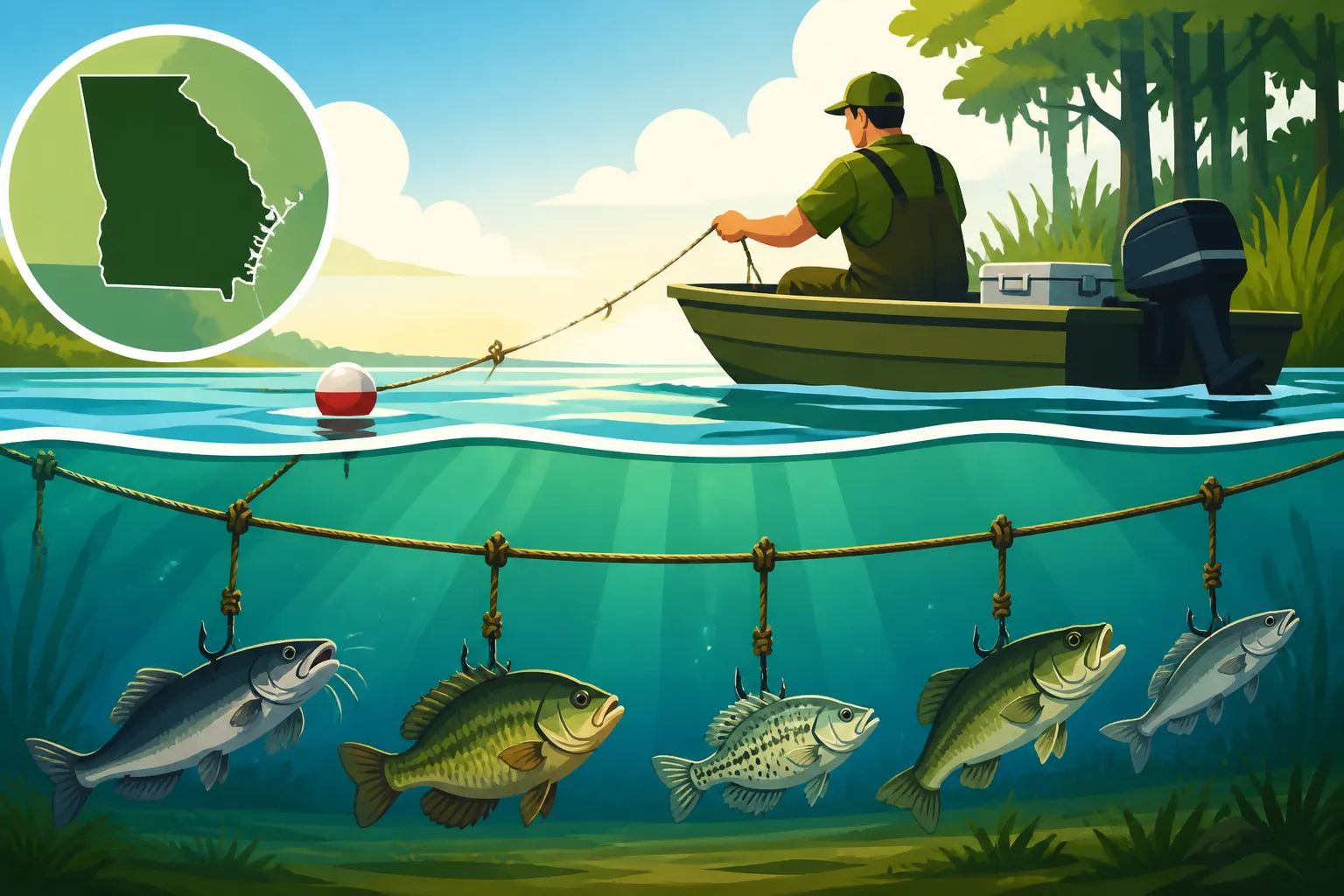
For those unfamiliar, a trotline is essentially a long fishing line strung across a body of water, from bank to bank or suspended between two anchor points, to which multiple baited hooks are attached at intervals. Think of it as a set of multiple individual fishing lines, all working simultaneously. This traditional method has been a staple in Southern fishing culture for generations, particularly for harvesting catfish and other bottom feeders. It's a passive fishing technique, meaning you set it up and then return later to check your catch, rather than actively casting and retrieving. This makes it incredibly efficient for anglers looking to catch a good quantity of fish.
The Basics of a Trotline
At its core, a trotline consists of a main line, usually a strong nylon or braided cord, which forms the backbone of the system. This main line is anchored securely at both ends to keep it taut and in position. Off this main line, you'll have shorter "stagings" or "gangions" – these are individual lines, typically 1 to 3 feet long, with a hook attached at their end. These stagings are tied to the main line at regular intervals, often spaced several feet apart to prevent tangles and give each bait enough room. Floats or buoys are usually attached to the main line, especially if it's being suspended in the water column, to mark its location and keep it from sinking too deep into the mud. The hooks themselves are typically sturdy, sharp, and sized appropriately for the target species, usually catfish.
Why Anglers Choose Trotlines
Anglers often turn to trotlines for several compelling reasons. The primary advantage is efficiency; you can deploy dozens of baited hooks at once, significantly increasing your chances of catching multiple fish compared to fishing with just one or two rods. This is especially true for species like Channel, Blue, and Flathead Catfish, which are often found in numbers and are opportunistic feeders. Many experienced anglers swear by trotlines for targeting larger, more elusive catfish that might not readily bite a rod and reel during the day. It allows you to fish prime nighttime hours or while you're away, maximizing your time on the water. It’s also a fantastic method for putting a substantial amount of fresh fish on the dinner table for a family or community fish fry. Plus, there's a certain satisfaction in the traditional aspect of setting and running a trotline, connecting with an age-old fishing practice.
Georgia's Regulations for Trotlines
Before you even think about buying your first spool of line, it's absolutely crucial to understand Georgia's specific regulations regarding trotlines. Fishing without proper knowledge of the rules can lead to hefty fines and confiscation of your gear. The Georgia Department of Natural Resources (DNR) takes these regulations seriously to ensure sustainable fishing practices and minimize conflicts among different types of anglers. Unlike a simple rod and reel, trotlines are considered "nongame commercial fishing gear" by some states, though in Georgia, they fall under specific recreational use guidelines. It’s important to remember that these rules are in place to manage fish populations and ensure public safety, so always double-check the latest Georgia Fishing Regulations Explained before you head out.
Permitted Waters and Gear
Not all waters are open to trotline fishing in Georgia. Generally, trotlines are permitted in public waters that are not designated as "trout waters" or certain other restricted areas like state park fishing ponds or specific management areas. Always consult the official Georgia DNR fishing regulations map or guide to ensure the water body you plan to fish is open to trotlines.
Regarding the gear itself, Georgia has specific limits on the construction and deployment of trotlines:
- Number of Hooks: A single trotline in Georgia waters cannot have more than 50 hooks. If you want to deploy more hooks, you'll need multiple trotlines, each adhering to the 50-hook limit.
- Spacing: Hooks must be spaced at least 3 feet apart. This is important to prevent tangles and give fish enough room.
- Line Material: The main line and stagings must be non-metallic. This usually means heavy-duty nylon, braided polyester, or similar synthetic materials. No steel cable or wire is allowed.
- Deployment: Trotlines must be set so that no part of the line or hooks is within 50 feet of any dock, swimming area, or boat launch. This is a critical safety measure to prevent entanglement with swimmers or boaters. They also can't obstruct navigation.
- Proximity to Other Gear: You cannot set a trotline within 50 feet of another trotline or a jug line. This helps prevent overcrowding of fishing gear.
These restrictions are designed to prevent overfishing in specific areas and reduce hazards for other water users. Always be mindful of your surroundings and other anglers.
Tagging and Identification Requirements
This is a frequently overlooked but incredibly important aspect of legal trotline fishing in Georgia. Every trotline you set must be clearly marked with your personal information. The Georgia DNR requires that each trotline have a waterproof tag attached to one of its buoys or anchors. This tag must include your full name and Georgia fishing license number. Without this identification, your trotline is considered illegal gear and can be confiscated by game wardens.
This tagging system serves multiple purposes. Firstly, it helps enforcement officers identify responsible anglers and ensure compliance with regulations. Secondly, it allows for easy identification if a trotline breaks loose or poses a hazard, enabling authorities to contact the owner. Finally, it discourages individuals from setting illegal or abandoned lines that could become "ghost fishing" hazards, continuing to catch and kill fish needlessly. It’s a simple step, but one that’s absolutely non-negotiable for lawful trotline fishing. You can often find durable, waterproof tags at bait shops or on online retailers like Amazon, perfect for jotting down your details.
Essential Gear for a Successful Trotline
Getting started with trotline fishing doesn't require a huge investment, but having the right gear can make all the difference in terms of safety, success, and compliance with regulations. Skimping on quality here can lead to lost gear, missed fish, or even dangerous situations. Think of your gear as an extension of your knowledge – it's there to help you execute your plan effectively and safely.
Choosing the Right Line and Hooks
The backbone of your trotline is, well, the line itself! You'll need a main line that is strong, durable, and resistant to abrasion from underwater structures, fish, and continuous water movement. Most experienced trotline anglers opt for heavy-duty braided nylon or similar synthetic lines. A breaking strength of at least 200-300 pounds is not uncommon for the main line, especially when targeting larger catfish species like those found in the Altamaha River or Flint River. Remember, this line needs to withstand the pull of potentially multiple large fish.
For the individual stagings (the shorter lines holding the hooks), a slightly lighter but still very strong line is appropriate, often in the 100-150 pound test range. Using a line with a slightly lower breaking strength for the stagings can sometimes be advantageous; if a hook snags or a massive fish puts too much strain on one section, only the staging might break, saving your entire main line and the rest of your hooks.
When it comes to hooks, size matters immensely. For catfish, circle hooks are highly recommended. Not only do they tend to hook fish in the corner of the mouth, making for easier, less harmful release of unintended bycatch, but they are also incredibly effective at self-setting. Common sizes for catfish trotlines range from 5/0 to 9/0, depending on the average size of fish you expect to catch. Always choose sharp, strong, and corrosion-resistant hooks. Brands like Mustad and Gamakatsu are popular choices among serious catfish anglers. You can often find bulk packs of these hooks on Amazon, which is a convenient way to stock up.
Anchors, Buoys, and Bait
These components are what keep your trotline in place, visible, and enticing to fish.
- Anchors: You'll need two sturdy anchors, one for each end of your trotline. The type and weight of the anchor will depend on the current, depth, and bottom composition of the water you're fishing. For slower-moving rivers or lakes, a heavy brick, a cinder block, or a dedicated mushroom anchor around 10-15 pounds might suffice. In stronger currents, you might need heavier, more aggressive anchors like grapple anchors or even multiple weights. The goal is to ensure your trotline stays exactly where you put it, even with multiple fish on the line.
- Buoys: These are crucial for marking your trotline's location and, in some setups, for keeping the main line suspended. Large, brightly colored jugs or buoys (often orange or yellow) are ideal. They need to be buoyant enough to support the weight of the line and any caught fish, and clearly visible from a distance, especially for other boaters. Again, remember the Georgia regulation: your personal identification tag with your name and fishing license number must be attached to at least one of these buoys.
- Bait: Ah, the million-dollar question for any catfish angler! The best bait often depends on the species of catfish you're targeting and the time of year. For Channel Catfish, traditional stink baits, chicken livers, cut bait (like shad or mullet), or even hot dogs are highly effective. Blue Catfish often prefer fresh cut bait, particularly oily fish like shad, herring, or skipjack. Flathead Catfish, on the other hand, are predators and almost exclusively prefer live bait – small bluegill, bream, or creek chubs are excellent choices. Using a variety of baits along your trotline can help you determine what's working best on a given day. Learn more about the best bait for Channel Catfish, Blue Catfish, and Flathead Catfish in Georgia to fine-tune your approach.
Setting Up Your Trotline in Georgia Waters
Now that you've got your gear sorted and you're familiar with the regulations, it's time to talk about actually deploying your trotline. This isn't just about tossing a line in the water; thoughtful placement and careful execution are key to both success and safety.
Finding the Perfect Spot
Locating the ideal trotline spot is perhaps the most critical step. Catfish are creatures of habit and prefer certain types of habitat. When scouting, consider these factors:
- Structure: Catfish love structure. Look for submerged timber, brush piles, rock formations, ledges, and deep holes. These areas provide cover, ambush points, and often hold forage fish. On large reservoirs like Lake Sinclair or Lake Oconee, deep creek channels and old riverbeds are prime targets.
- Current: In rivers, catfish will often position themselves just out of the main current, in eddies or behind obstacles, where food washes to them without expending too much energy. In lakes, look for subtle current breaks, especially near points or humps.
- Depth: While catfish can be found at various depths, especially during different seasons, they often relate to deeper water during the day and move shallower at night to feed. A trotline set in deeper channels or along ledges that transition from shallow to deep can be very effective.
- Forage: Where the baitfish are, the catfish usually aren't far behind. If you see signs of schooling baitfish (shad, bream), you're likely in a good area.
- Accessibility: Consider how you'll retrieve your trotline. Can you safely access both ends by boat or from the bank? Remember the 50-foot rule regarding docks, swimming areas, and boat launches. Always ensure your chosen spot is legal and doesn't impede navigation. Some of the Best Catfish Fishing Spots in Georgia might be ideal for this technique.
Deployment Techniques
Once you've identified your spot, careful deployment is essential. This is often a two-person job, especially for longer lines, to ensure safety and prevent tangles.
- Preparation: Before leaving the bank or dock, make sure all your hooks are pre-baited. This will save a lot of time and hassle on the water. Keep the hooks organized and covered to prevent accidental snagging.
- Anchor One: Start by securing your first anchor firmly to the bank or dropping it precisely from your boat. Make sure it's not going to budge. Attach one of your main buoys with your identification tag to this anchor line.
- Laying the Line: Slowly motor or paddle away from the first anchor, carefully paying out the main line. As you go, ensure the stagings with hooks don't tangle and the main line doesn't get snagged. If using a suspended line, make sure your mid-line floats are keeping it at the desired depth. Maintain tension as you move to keep the line straight.
- Anchor Two: Once you reach your desired length (up to 50 hooks max in Georgia), secure the second anchor. Again, attach a buoy to this end, clearly marking the end of your line.
- Check Tension and Depth: After deployment, circle back and ensure the line is taut and at the desired depth, with all buoys visible. Make any necessary adjustments.
A common setup is to stretch the trotline between two trees on opposite banks of a narrow river, or between two heavy anchors in a lake. Another method involves suspending the trotline in deeper water using multiple buoys along its length, keeping the baited hooks just off the bottom. Remember, safety first! Always wear a life jacket, especially if you're working with heavy anchors or in strong currents.
Baiting and Checking Your Trotline
The thrill of trotlining comes from the anticipation of checking your line and seeing what bounty awaits. But even after deployment, there are still best practices for baiting and maintenance that can significantly impact your success.
Best Baits for Georgia Catfish
As we touched on earlier, bait choice is paramount, and it often comes down to targeting specific catfish species.
- Channel Catfish: These are often the most common catch on trotlines. They have an incredible sense of smell and are drawn to strong, pungent odors. Excellent choices include chicken livers, cut chunks of shad, bluegill (cut or whole small ones if legal and appropriately sized), shrimp, nightcrawlers, and commercially prepared "stink baits." Dough balls flavored with cheese or anise can also work. If you're using chicken livers, try curing them overnight with garlic salt to make them tougher and stay on the hook better.
- Blue Catfish: These powerful fish often grow to impressive sizes in Georgia's larger river systems and reservoirs like the Savannah River or Lake Seminole. They are primarily scavengers but will readily attack fresh cut bait. Oily fish like shad, herring, mullet, or even pieces of carp are top choices. The fresher the better! Ensure your pieces are large enough to attract big blues but still fit on your hook.
- Flathead Catfish: The true apex predator of Georgia's catfish species, Flatheads have a distinct preference for live bait. They rarely go for stink baits or cut bait unless it's exceptionally fresh and still twitching. Small live bluegill, sunfish, creek chubs, or other small baitfish (ensure they are legal size and species to use as bait) are your best bet. Hook them carefully through the back or lips to keep them alive and active for as long as possible. The movement of the live bait is what triggers a Flathead's predatory instinct. You can find detailed information on Best Bait for Flathead Catfish to maximize your chances.
When baiting, try to ensure the bait is securely fastened to the hook. Circle hooks are excellent for this, as the bait can be threaded on to cover the hook shank, leaving the point exposed for a clean hook-set. Consider using a variety of baits along your line to see what the fish are biting on that day.
Regular Checks and Maintenance
Once your trotline is deployed and baited, the work isn't over. Regular checks are essential for maximizing your catch, ensuring humane treatment of fish, and maintaining the legality and safety of your setup.
- Frequency of Checks: In Georgia, regulations stipulate that trotlines must be checked at least once every 24 hours. However, for best results and ethical practice, many anglers check their lines more frequently, often in the early morning and late evening, or even multiple times a day if feasible. This is especially important in warmer weather, as fish can spoil quickly on the line.
- Retrieval and Re-baiting: When you check your line, carefully approach one end, grab your buoy, and begin hauling in the main line. As you go, remove any caught fish, re-bait any hooks that have lost their bait, and untangle any snags. Handle fish humanely; if you plan to release fish, do so quickly and carefully. For fish you're keeping, dispatch them swiftly and place them on ice immediately.
- Inspection: Take this opportunity to inspect your line, hooks, and anchors. Look for any fraying, weak points, bent hooks, or issues with your anchors. Repair or replace any damaged components. A small repair kit with extra line, hooks, and tools is invaluable to have on hand.
- Safety First: Always be cautious when handling hooks, especially with a line full of fighting fish. Keep a pair of pliers or a hook remover handy. Be mindful of your boat's stability, especially if you're leaning over the side to retrieve the line. If you fish at night, ensure you have adequate lighting and know the rules for Night Fishing Techniques for Catfish.
This regular maintenance not only keeps your gear in good working order but also minimizes the chances of "ghost fishing" from lost or abandoned lines and ensures that fish aren't left on the line for extended, cruel periods.
Safety and Ethical Considerations
Trotline fishing, like any other outdoor activity, comes with inherent risks and responsibilities. As a thoughtful angler, it's paramount to prioritize safety for yourself and others, and to fish ethically to protect Georgia's precious aquatic resources. A little foresight goes a long way in ensuring a positive experience for everyone on the water.
Avoiding Entanglement and Hazards
A poorly placed or improperly maintained trotline can quickly become a nuisance or even a danger.
- For Boaters and Swimmers: The 50-foot rule from docks, swimming areas, and boat ramps isn't just a suggestion; it's a critical safety measure. Imagine a swimmer or a boat propeller encountering an unmarked or improperly marked trotline. The consequences could be severe, from serious injury to damage to property. Always ensure your buoys are brightly colored and highly visible. Consider adding reflective tape for night visibility if allowed.
- For Wildlife: Turtles, waterfowl, and other non-target species can become entangled in trotlines. While it's impossible to entirely prevent this, good practices can minimize it. Using appropriate hook sizes (not too small) and setting your lines where non-target species are less likely to frequent can help. If you do find entangled wildlife, approach with extreme caution and, if possible and safe, try to release them. If the situation is dangerous or you're unsure, contact the Georgia DNR.
- For Yourself: Handling dozens of baited hooks and potentially large, thrashing fish requires care. Wear sturdy gloves to protect your hands from hooks, spines, and abrasive lines. Keep a first-aid kit readily accessible, especially for hook injuries. When deploying or retrieving the line, ensure you maintain balance in your boat and are aware of any changing conditions like strong currents or weather.
Minimizing Bycatch and Promoting Conservation
Responsible angling extends beyond just following the law; it involves actively minimizing your impact on the ecosystem.
- Bycatch: Trotlines can occasionally catch species other than your intended target. This is known as bycatch. To minimize this, use species-appropriate baits and hook sizes. For example, using live bait for Flatheads is more likely to catch Flatheads, whereas smaller baits might attract more panfish or smaller catfish.
- Release Practices: If you catch a fish that is undersized, over the creel limit, or simply not a species you wish to keep, it's your responsibility to release it quickly and with the best chance of survival. Circle hooks are excellent for this as they typically hook fish in the mouth, reducing gut hooking. Handle the fish gently, support its body, and release it back into the water as soon as possible. Avoid unnecessary time out of water.
- Respecting Limits: Always adhere to Georgia's daily creel and size limits for all fish species. These limits are scientifically determined to ensure sustainable fish populations for future generations. Don't be tempted to keep more than your legal limit, even if your trotline yields a massive haul.
- Leave No Trace: When you pack up your trotline, ensure you remove all your gear, including any stray lines, hooks, or discarded bait. Leave the area cleaner than you found it. This helps preserve the beauty and health of Georgia's waterways for everyone.
By understanding and practicing these safety and ethical guidelines, you can enjoy the rewarding experience of trotline fishing while being a responsible steward of Georgia's natural resources. It’s about more than just catching fish; it’s about participating in a cherished tradition with respect for the environment and fellow outdoors enthusiasts.
| Catfish Species | Preferred Bait Type | Hook Size Range | Common Habitat | Time of Day |
|---|---|---|---|---|
| Channel Catfish | Stink bait, Cut bait, Chicken Livers, Worms | 5/0 – 7/0 | Rivers, Lakes, Ponds; often near structure | Day & Night |
| Blue Catfish | Fresh Cut Bait (Shad, Herring, Mullet), Live Bait | 7/0 – 9/0 | Large Rivers, Reservoirs; deep channels | Day & Night |
| Flathead Catfish | Live Bait (Bluegill, Sunfish, Chubs) | 7/0 – 9/0 | Rivers; heavy cover, submerged timber | Primarily Night |
Disclaimer
The information provided in this guide is for general informational purposes only and does not constitute legal advice. Fishing regulations, licensing requirements, and waterway access rules are subject to change. Always consult the most current Georgia Department of Natural Resources (DNR) fishing regulations and local ordinances before engaging in any fishing activity. It is the responsibility of the individual angler to be aware of and comply with all applicable laws and regulations.