Where to Put Your Georgia Boat Registration Decal
It's a familiar scene on Georgia's beautiful waterways: you've got your boat, your gear, and you're ready to hit the lake or coast. But then a little anxiety creeps in. Did you put that boat registration decal in the right spot? It might seem like a small thing, but getting it wrong can lead to unnecessary headaches, or even a chat with local law enforcement. This guide is here to clear up all the confusion, so you can confidently display your registration and focus on what truly matters: a great day of fishing.
The Basics of Georgia Boat Registration Decals
Understanding the "why" behind boat registration decals can sometimes make the "how" and "where" a little clearer. It's not just a bureaucratic hoop to jump through; it's about ensuring safety, proper identification, and responsible boating for everyone sharing our waters.
Why Decal Placement Matters
Let's be honest, nobody wants to be pulled over on the water. It can put a real damper on a perfectly good fishing trip. Proper decal placement isn't just a suggestion; it's a legal requirement designed to make your vessel easily identifiable and to show that you're operating legally. Game wardens and marine patrol officers need to quickly verify that your boat is registered and current without having to flag you down every time. Imagine trying to identify thousands of boats on Lake Lanier or the Altamaha River if everyone just slapped their decal anywhere! Incorrect placement, or a missing decal, is a red flag that could lead to a stop, a conversation, and potentially a citation. It’s definitely a frustration we all want to avoid. Just like understanding Georgia Fishing Regulations Explained, knowing your decal rules keeps you in good standing.
What Your Decal Signifies
That little sticker, often no bigger than a playing card, is actually a powerful piece of information. It signifies that your boat is officially registered with the state of Georgia, that you've paid the necessary fees, and that your registration is current for the given period. Each decal typically bears a year, indicating its expiration. It's proof that your vessel is legitimate and authorized to be on Georgia's lakes, rivers, and coastal waters. Think of it like a vehicle tag for your boat; it confirms your compliance with state regulations. When you buy a new boat or renew an existing registration, getting that fresh decal properly affixed is the final step in ensuring you're good to go.
The Specifics: Where to Affix Your Decal
Now for the nitty-gritty: the exact location. Georgia's regulations are pretty clear on this, and sticking to the rules will save you any trouble down the line.
The Starboard Bow – Your Primary Location
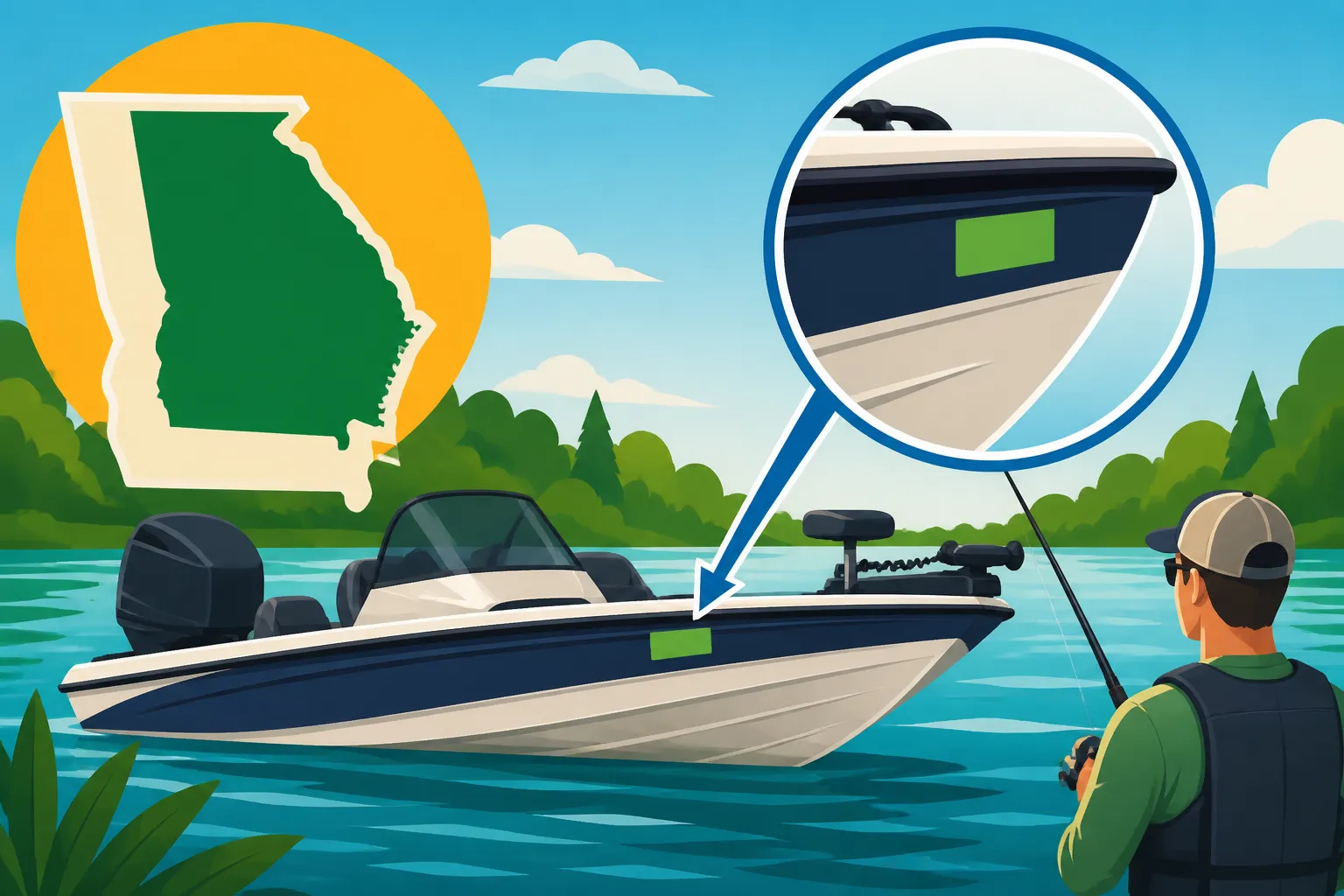
When it comes to your Georgia boat registration decal, there's one golden rule: it needs to go on the starboard bow of your vessel. For those newer to boating terminology, "starboard" means the right side of the boat when you're facing forward towards the front (the bow). So, you're looking for the front-right section of your hull.
Why this specific spot? Visibility, pure and simple. This location ensures that the decal is easily visible from other vessels and from the shore, even when your boat is underway or docked. It needs to be placed high enough above the waterline to be seen clearly, and in a spot that isn't obstructed by docking lines, fenders, or other gear. You don't want it hidden away near the anchor or tucked behind a cleat. The idea is to make it as obvious as your boat's registration number itself. Choosing a flat, clean surface on the starboard bow that allows the decal to lay smoothly and securely is key to long-term adherence and visibility.
Positioning Relative to Your Registration Number
Okay, so you've got the starboard bow down, but what about its relationship to your actual boat registration number? Those large letters and numbers that identify your vessel. The decal isn't just floating out there on its own.
Georgia regulations specify that the validation decal must be placed within six inches to the rear of and in line with the vessel's registration number. So, imagine your registration number — for example, "GA 1234 AB" — displayed prominently on your bow. Your current year decal should be positioned just behind the last character of that number, staying on the same horizontal plane. It effectively acts as a visual stamp of approval for the number itself.
Here's a quick visual breakdown:
| Element | Location Guideline |
|---|---|
| Registration Number | Each side of the bow, contrasting color, block characters, 3" min. height |
| Decal | Within 6 inches to the rear of the registration number, in line with it |
This specific placement ensures that when an officer scans your boat's registration number, their eye naturally falls on the current validation decal. It creates a neat, organized, and easily digestible identification system. Avoid placing the decal too far below or above the number, or covering any part of the number itself. It might sound particular, but these details are crucial for compliance. For more details on boat identification, check out Where to Display Your Georgia Boat Decal Correctly.
Understanding Decal Requirements for Different Boat Types
Not all boats are created equal when it comes to registration and decals. The type of vessel you operate plays a significant role in whether you even need a decal in the first place.
Motorized Vessels (Including Canoes and Kayaks with Motors)
This is where the majority of confusion often lies. If your vessel has a motor, regardless of its size or type, it generally needs to be registered in Georgia, and therefore, it will require a registration decal. This includes your typical bass boats, pontoons, runabouts, and even sailboats with an auxiliary motor.
But here's a crucial point that often surprises people: it also applies to canoes, kayaks, and other small craft if they are propelled by any mechanical means. That tiny electric trolling motor you've got rigged up on your kayak for fishing those quiet coves? Yep, that makes your kayak a motorized vessel in the eyes of the law, and it will need a Georgia registration number and a decal. It's not about the horsepower; it's about the presence of a motor. So, if you're hitting the water on your Kayak Fishing Gear Guide for Beginners journey and it's got a motor, make sure it's registered! You can find more specific guidance on How to Register a Kayak or Canoe in Georgia.
The size of your boat doesn't change where the decal goes, but it can affect the practicality. On a large bass boat, finding that flat spot on the starboard bow is usually no problem. On a smaller, often more curved kayak, you might need to be a bit more selective to ensure the decal adheres smoothly and remains clearly visible without getting crinkled or peeling. Just remember, if it moves under its own mechanical power, it needs that sticker!
Non-Motorized Vessels: When Decals Aren't Needed
Now for some good news for those who prefer paddle power! If your canoe, kayak, rowboat, or even your stand-up paddleboard is exclusively propelled by human power (paddles, oars, pedals, sails without auxiliary motors), then you typically do not need to register it in Georgia, and consequently, you won't need a registration decal. This is a common exemption that simplifies things for many recreational paddlers.
However, it's absolutely critical to remember the "exclusively" part of that statement. As soon as you attach even the smallest electric motor, a gas outboard, or any other mechanical propulsion device, your vessel loses its non-motorized status. At that point, it instantly falls under the same registration requirements as any other motorized boat. So, before you head out, double-check if your vessel truly qualifies as non-motorized. If you're ever in doubt, it's always safer to check the official guidelines or register it. Knowing Which Boats Are Exempt From Registration in Georgia can save you a lot of guesswork and potential hassle. This distinction is important for casual weekenders and serious anglers alike, ensuring everyone understands their obligations on the water.
Common Mistakes and How to Avoid Them
Even with the best intentions, it's easy to make mistakes when it comes to boat registration and decal placement. Being aware of these common pitfalls can help you steer clear of trouble.
Expired Decals and Improper Placement Penalties
We've all been there: life gets busy, and sometimes renewals slip through the cracks. But when it comes to your boat registration decal, an expired sticker is just as problematic as no sticker at all. Law enforcement officers are trained to spot these things, and an out-of-date decal tells them your registration isn't current. The consequence? At best, a warning and the inconvenience of having to deal with it on the spot; at worst, a citation and a fine. The state takes boat registration seriously, not just for revenue, but for safety and accountability on the water.
Similarly, an improperly placed decal can lead to the same issues. If it's on the wrong side of the boat, too far from the registration number, obscured, or falling off, it doesn't meet the legal requirements for clear identification. It's frustrating to think you're in compliance only to find out a small oversight can land you in hot water. While it might not be as severe as the Penalties for Fishing Without a License in Georgia, it's still an avoidable hassle. Make sure to keep an eye on your Georgia Boat Registration Renewal Deadline Explained so you don't get caught off guard. And if you completely neglect registration, understand What Happens if You Don't Register Your Boat in Georgia.
Tips for Clean and Secure Decal Application
Applying a decal seems simple enough, but a rushed or careless job can lead to bubbles, wrinkles, or peeling, which then makes your valid decal look sloppy or even unreadable. Here's how to do it right:
- Clean the Surface Thoroughly: This is paramount. The area on your starboard bow where the decal will go must be free of dirt, grime, wax, or old adhesive residue. Use a mild boat soap and water, or a specialized marine cleaner. Dry the area completely. Any moisture trapped underneath will prevent proper adhesion. You can find excellent boat cleaning supplies at stores like Bass Pro Shops or even general-purpose cleaners on Amazon that are safe for marine surfaces.
- Temperature Matters: Apply decals when the air temperature is moderate, ideally between 60-80°F (15-27°C). Applying in extreme heat can make the decal too pliable and prone to stretching, while extreme cold can make the adhesive less effective.
- Position Carefully: Before peeling off the backing, hold the decal in place to confirm the exact positioning relative to your registration number. Mark it with a piece of painter's tape if you need a guide.
- Peel Slowly, Apply Smoothly: Once you're confident in the placement, peel back a small section of the decal's backing paper. Align it, and then slowly press the exposed adhesive onto the boat surface, working your way across while steadily peeling the rest of the backing. Use a squeegee (even a credit card wrapped in a soft cloth can work) to smooth out bubbles as you go, pushing them towards the edges.
- Cure Time: Allow the decal some time to cure and fully adhere before exposing it to harsh conditions, like heavy rain or direct sun for prolonged periods, if possible. This helps ensure it forms a strong bond.
Taking these few extra minutes can ensure your decal stays put and looks sharp for its entire validity period.
Decal Placement on Inflatable Boats and Unique Hulls
Some boats present unique challenges for decal placement. Inflatable boats, for example, don't always offer a perfectly rigid, flat surface. The same can be true for boats with highly curved bows or textured finishes.
For inflatable boats, the key is to find the flattest, smoothest section on the starboard bow that remains taut when the boat is inflated. Avoid seams or areas that frequently flex. Many inflatable boats have specific reinforced patches or flatter sections designed for registration numbers and decals. If your inflatable has fabric that isn't ideal for direct adhesive, some boaters opt for a rigid plate that is securely attached to the boat, onto which the decal is then affixed. This ensures stability and visibility.
For vessels with unusual hull designs, the principle remains the same: choose the most prominent, flat, and unobstructed area on the starboard bow. If the bow is exceptionally curved, try to find a spot where the decal can still lay mostly flat without excessive bending or creasing. Sometimes, this might mean positioning it slightly further back on the bow than you would on a traditional rigid hull, as long as it's still clearly on the forward quarter and within the legal proximity to your registration number. Always prioritize visibility and secure adhesion over absolute precision if your boat's design makes exact placement difficult.
Keeping Your Registration Current and Accessible
A correctly placed decal is only half the battle; maintaining current registration and having your documents handy are equally important aspects of responsible boating.
The Importance of Renewal and Timeliness
Just like your car tags, your Georgia boat registration and its accompanying decal have an expiration date. Ignoring it can be a costly mistake. Typically, boat registrations in Georgia are valid for a specific period, often three years. It's easy to forget when that renewal date rolls around, especially if you only boat seasonally. However, failing to renew means you're operating an unregistered vessel, which can lead to fines and legal complications.
Many states send out renewal notices, but it's ultimately your responsibility to keep track of your registration status. Set a reminder on your phone, mark it on your calendar, or even create a recurring task to check your boat's registration annually. Renewing on time ensures you receive a fresh decal to replace your expired one, keeping you in full compliance. Understanding How Long Does a Georgia Boat Registration Last can help you plan ahead. Taking a proactive approach means less stress and more enjoyment on the water.
What to Do If Your Decal is Damaged or Lost
Things happen. Decals can get scratched, faded by the sun, peel off due to wear and tear, or even get lost if a piece of your boat's hull gets damaged. If your current validation decal becomes unreadable, damaged, or goes missing, you cannot simply continue operating your boat as if everything is fine. An unidentifiable or missing decal is the same as an expired one in the eyes of the law.
The good news is that replacing a damaged or lost decal is usually a straightforward process. You'll typically need to contact the Georgia Department of Natural Resources (DNR) or the relevant state agency that handles boat registration. There might be a small fee for a replacement decal, and you'll likely need to provide your boat's registration number and some identification. Don't wait until you're pulled over to address the issue. Order a replacement as soon as you notice a problem. Until you have that new, clearly visible decal, it's best to avoid operating your boat to ensure you remain compliant. If you need a refresher on where to put that new one, you can always refer back to this guide for Where to Put Your Georgia Boat Registration Decal.
Navigating Other Boat Identification Requirements
While the decal is a small but mighty part of boat identification, it's just one piece of a larger puzzle. To be fully prepared and compliant, you need to understand other related requirements too.
Displaying Your Registration Number Correctly
The decal works in tandem with your boat's registration number, which is a unique identifier assigned to your vessel. These numbers aren't just decorative; they have very specific display requirements in Georgia. They must be:
- Block Characters: No fancy fonts or script.
- At least three inches in height: Easily visible from a distance.
- Contrasting Color: The color of the numbers must sharply contrast with the color of your boat's hull. For example, dark numbers on a light hull, or light numbers on a dark hull. This ensures maximum readability.
- Permanently Attached: The numbers must be painted or permanently attached as decals. They can't be temporary, like taped-on paper.
- Displayed on Both Sides of the Bow: The number should appear on both the port (left) and starboard (right) sides of the forward half of your boat.
Following these rules for your actual registration number makes it easy for officials to identify your boat quickly and efficiently. Just as important as where you put your decal is understanding Where to Display Your Georgia Boat Decal Correctly alongside your vessel number. You can often purchase compliant numbering decals from marine supply stores or through online retailers like Amazon or Bass Pro Shops.
Proof of Ownership and Other Documents
Beyond the physical decals and numbers on your boat, you also need to carry specific documents with you while operating your vessel. This is similar to needing your driver's license and vehicle registration in your car.
The most crucial document is your Georgia boat registration card. This card serves as official proof that your vessel is registered and that you are authorized to operate it. Keep it in a waterproof container, like a sturdy dry bag, in an easily accessible but secure location on your boat. If an enforcement officer ever requests to see your registration, you'll need to produce this card.
Depending on the situation, you might also want to have proof of ownership, such as the vessel's title, especially if it's a newer boat or if you've recently transferred ownership. While not always required to be on the boat, having access to these documents can clear up any questions quickly. Make sure to understand the Georgia Boat Titling Process Explained if you're buying or selling a boat. Being organized with your paperwork means less time explaining and more time fishing.
Disclaimer
This article is for general informational purposes only and does not constitute professional advice. Laws, prices and regulations vary by location and change over time. Consult a qualified professional for guidance on your specific situation.