Daily Creel Limits for Trout in Georgia
One of the most common headaches for trout anglers in Georgia isn't necessarily finding the fish; it's keeping up with the ever-changing daily creel limits and size regulations! It can feel like you need a law degree just to figure out how many beautiful rainbow, brown, or brook trout you can legally take home. This guide is here to clear up that confusion, breaking down the general rules, special exceptions, and what you absolutely need to know to stay on the right side of the law while enjoying Georgia's incredible trout streams.
Understanding Georgia's General Trout Creel Limits
When you're out on the water, rod in hand, the last thing you want is to accidentally break a regulation. It's a common fear, and for good reason—Georgia's trout fishing rules can get a little complex, especially when it comes to how many fish you can keep. Let's start with the basics, because understanding the "general regulation" waters is your first step to a worry-free fishing trip.
The Standard Daily Catch
For the vast majority of Georgia's trout waters, what we call "general regulation" streams, the daily creel limit for trout is 8 fish. This limit applies to all three major trout species you'll encounter: rainbow, brown, and the native brook trout. Now, this doesn't mean you have to keep 8 fish every time you go out. Many anglers practice catch and release, or only keep a few for a delicious dinner. But if you choose to harvest, 8 is the magic number for most places. It's a fairly generous limit, designed to allow anglers to enjoy their sport while still protecting the overall fish population.
However, there's often a minimum size limit that goes hand-in-hand with that creel limit. On general regulation waters, any trout you keep must be at least 6 inches long. This small detail is super important, because throwing back undersized fish is crucial for the health of the fishery. It ensures that younger fish have a chance to grow, mature, and contribute to future generations of trout. Always carry a small measuring tape or a ruler affixed to your tackle box to quickly check your catch before deciding to keep it. You don't want to get home and realize your prize catch is actually too short!
Why Creel Limits Matter
You might wonder why we even have these limits in the first place. Isn't fishing just about enjoying nature? Well, yes, but it's also about conservation, and that's where creel limits truly shine. These regulations are scientifically determined by the Georgia Department of Natural Resources (DNR), specifically the Wildlife Resources Division. They look at factors like stocking numbers, natural reproduction rates, habitat quality, and angler pressure. The goal is a delicate balance: providing ample opportunity for anglers to enjoy their sport while preventing overfishing that could deplete trout populations.
Without these limits, it wouldn't take long for even the most robust trout streams to suffer. Imagine if everyone kept every fish they caught—our streams would quickly be barren. Creel limits ensure that there are enough fish left in the stream to reproduce, to provide sport for other anglers, and to maintain a healthy ecosystem. It's a shared responsibility, and every angler plays a part in respecting these rules, even if they sometimes feel a little cumbersome. Understanding the spirit behind the law can make it a lot easier to follow. If you're looking for more general information, our guide on Georgia Fishing Regulations Explained dives deeper into the broader legal landscape.
The "Trout Stamp" and Its Role
Before we delve deeper into specific stream exceptions, it's essential to touch on the "trout stamp," or more accurately, the Mountain Trout License add-on. Many folks mistakenly think this special license impacts the number of fish they can keep. In reality, it doesn't directly change the daily creel limit itself. What it does do is grant you the legal right to fish for trout in designated trout waters, particularly those in the mountain counties of North Georgia where most of our trout streams are found.
Think of it this way: your basic Georgia fishing license allows you to fish for most freshwater species across the state. But if you want to target trout in those special trout streams, you need that extra "trout stamp." It's an additional permit required on top of your base license, and the revenue generated from these add-ons goes directly back into trout management programs, including stocking efforts and habitat improvement. So, while it doesn't dictate your creel limit, it's a vital piece of the puzzle for legal and responsible trout fishing. You can find more details on Georgia Trout Fishing License Requirements to ensure you're fully licensed before hitting the water.
Special Regulation Trout Waters: When Limits Change
Not all trout waters are created equal in Georgia, and neither are their creel limits. The DNR manages certain streams with special regulations to achieve specific conservation or recreational goals. This is where things can get a little tricky, and paying close attention to signage at access points or checking the official regulations guide is absolutely crucial. Missing a special regulation can lead to significant penalties, even if it was an honest mistake.
Delayed Harvest Streams: Catch and Release for Most of the Year
One of the most popular special regulations applies to Georgia's Delayed Harvest (DH) trout streams. These streams, such as the Amicalola Creek, Chattahoochee River (sections), Smith Creek, and the Toccoa River (sections), operate under a unique system. From November 1st through May 14th, these waters are strictly catch-and-release only. This means you cannot keep any trout, regardless of size or species, during this period. The idea is to stock these streams heavily in the fall, allow anglers to enjoy abundant catch-and-release fishing all winter and spring, and then open them up to harvest during a shorter summer season.
It's a fantastic program that offers incredible opportunities for anglers to hone their skills and experience high catch rates without depleting the resource. However, come May 15th, the rules change significantly. From May 15th through October 31st, the daily creel limit for these streams reverts to the general statewide regulation of 8 trout per day, with a 6-inch minimum size. This sudden shift often catches new anglers off guard, so it's paramount to know the specific dates. Our detailed guide on What is delayed harvest trout fishing in Georgia? explains this unique system further. You'll find specific dates and streams listed there.
Trophy Trout Streams: Targeting Quality Over Quantity
Georgia also manages a handful of streams as "Trophy Trout" waters. These areas are specifically designed to grow larger, more mature trout, often through special stocking programs and highly restrictive regulations. The focus here is on quality over quantity. An excellent example is a section of the Chattahoochee River below Buford Dam. While the general sections of the Hooch might have a higher creel, the trophy sections typically have a much lower daily limit, sometimes as low as one or two fish per day, and a significantly higher minimum size limit, often 18 to 22 inches.
The rationale for these stricter rules is to allow trout to live longer, grow larger, and become true trophy specimens. This offers a unique challenge and reward for anglers seeking that once-in-a-lifetime catch. It also helps to distribute fishing pressure, giving anglers a choice between high-volume general regulation fishing or challenging trophy hunting. Always consult the latest Georgia Fishing Regulations Summary, which you can usually find on the Georgia DNR website or at local tackle shops, to confirm the precise limits for any designated trophy water you plan to visit.
Specific Stream Exceptions and Their Rules
Beyond Delayed Harvest and Trophy Trout sections, some individual streams or stream sections have their own unique rules that don't fit neatly into the other categories. These are often smaller, more sensitive fisheries or areas with specific conservation goals. Two prime examples are Waters Creek and Noontootla Creek.
-
Waters Creek: This stream, located within the Smithgall Woods State Park, is a fly-fishing-only, catch-and-release stream year-round. There is no creel limit because all fish must be immediately released unharmed. It's a true gem for those who want to experience pristine trout fishing in a natural setting. Anglers must make reservations to fish here, and specific rules apply to tackle and techniques. Our article on Waters Creek Trout Size Rules, Georgia offers more details on this unique spot.
-
Noontootla Creek: Parts of Noontootla Creek also have very specific regulations, often falling into a "no bait" or "artificial lure only" category, and can have an 18-inch minimum size limit for certain trout species or be entirely catch-and-release. These rules are put in place to protect wild trout populations and ensure they can reproduce successfully. Understanding the intricacies of Noontootla Creek Trout Minimum Length is vital if you plan to visit this beautiful but sensitive area.
These hyper-specific regulations are a testament to how carefully Georgia manages its fisheries. It might seem like a lot to remember, but each rule serves a purpose in maintaining healthy, sustainable trout populations for all of us to enjoy.
Here's a handy table summarizing the different daily creel limits and size regulations for various trout waters in Georgia:
| Water Type | Daily Creel Limit | Minimum Size Limit | Special Conditions |
|---|---|---|---|
| General Regulation Streams | 8 Trout | 6 inches | Applies to most non-designated trout waters |
| Delayed Harvest (Nov 1 – May 14) | 0 Trout | Catch & Release | Artificial lures only, single hook |
| Delayed Harvest (May 15 – Oct 31) | 8 Trout | 6 inches | General regulations apply |
| Trophy Trout Waters | 1-2 Trout (varies) | 18-22 inches (varies) | Specific sections, often artificial lure only |
| Waters Creek | 0 Trout | Catch & Release | Fly fishing only, barbless hooks, reservations required |
| Noontootla Creek (Specific Sections) | 0 or 1 Trout (varies) | 18 inches (varies) | Artificial lure only, single hook, check specific rules |
Identifying Your Catch: Understanding Trout Species and Size
Knowing the rules is one thing, but confidently identifying the fish you've caught and accurately measuring it is another skill entirely. Many new anglers find themselves scratching their heads, wondering if they've got a rainbow or a brown, or if that fish really hits the 6-inch mark. Don't worry, you're not alone! It's a fundamental part of responsible trout fishing, and it gets easier with practice.
Differentiating Rainbow, Brown, and Brook Trout
Georgia's trout streams are primarily home to three species: rainbow trout, brown trout, and brook trout. Each has distinct characteristics, and being able to tell them apart is crucial, especially if specific regulations apply to certain species (though generally, creel limits often apply to "trout" collectively, size limits can differ in some special management areas).
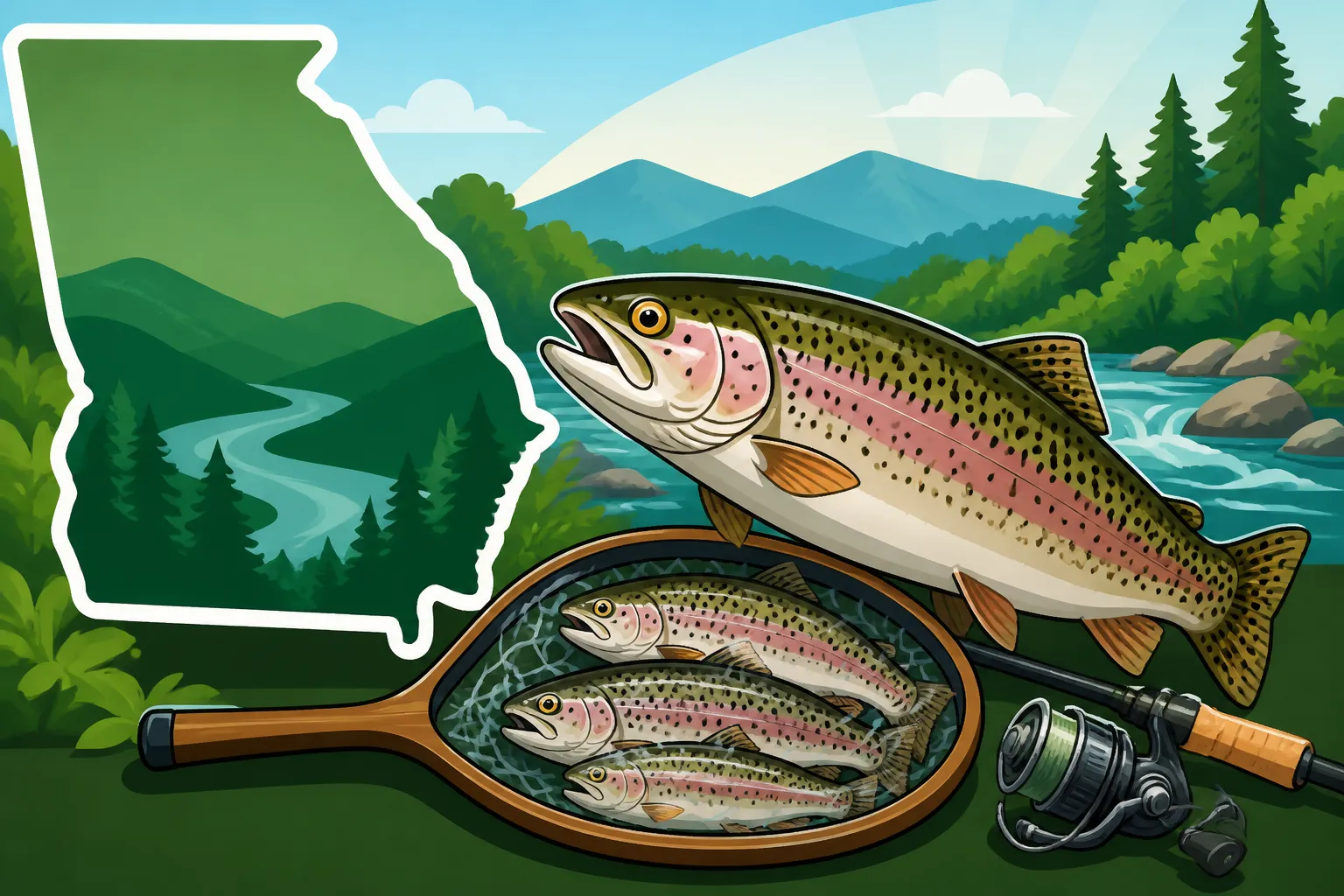
- Rainbow Trout: These are by far the most commonly stocked trout in Georgia. They're easily recognizable by the broad, pinkish-red stripe running horizontally along their sides, from gill plate to tail. Their bodies are typically covered in small black spots, including on their dorsal, adipose, and caudal fins. Their tail is often slightly forked.
- Brown Trout: Brown trout tend to be a bit more elusive and are known for their beautiful golden-brown or olive-brown bodies. They have fewer, larger spots, which are usually dark brown or black, often with a pale halo around them. They also typically have some red or orange spots, particularly along their sides. The tail of a brown trout is usually square or slightly emarginate, and it generally lacks spots.
- Brook Trout: Georgia's only native trout species, brook trout are stunning but often smaller. They have a dark, worm-like pattern (vermiculations) on their backs and dorsal fins, and distinct red and white spots (called "halos" or "areolae") on their sides. Their lower fins often have a white leading edge, followed by black, and then red or orange. These vibrant colors are a dead giveaway. You can learn more about Brook Trout: Georgia's Only Native Trout Species if you want to target these beautiful native fish.
Take a moment to observe your catch before deciding whether to keep or release. If you're unsure, it's always best to err on the side of caution and release the fish. A small, laminated identification card or a quick search on your phone (if you have service!) can be a lifesaver.
The Importance of Measuring Your Fish Accurately
The 6-inch minimum size limit for general regulation waters might seem straightforward, but how you measure can make all the difference. The official way to measure a fish is from the tip of its snout (mouth closed) to the very tip of its tail, with the tail compressed. Don't measure along the curve of the body, and make sure the tail isn't fanned out, which can give you a deceptively longer measurement.
It's absolutely vital to use a reliable measuring device. A small, flexible tape measure is perfect, or you can purchase a dedicated fish measuring board. You can find many inexpensive options, like a folding ruler or a soft tape measure, on Amazon that fit perfectly into a small tackle box or vest pocket. Many anglers will even mark their fishing net handles or rods with 6-inch increments as a quick reference, though a proper ruler is always best for accuracy. Remember, a fish that's barely 5.5 inches is still undersized, and keeping it could result in a citation. When in doubt, let it grow!
Georgia's Native Brook Trout Considerations
While the general creel limit of 8 fish and 6-inch minimum applies to all trout species on general waters, there's a special reverence for Georgia's native brook trout. These fish are true survivors, holding on in the highest, coldest, and most pristine headwater streams of North Georgia. Because of their sensitive nature and relatively small populations, many anglers choose to release all brook trout they catch, regardless of regulations.
Even in areas where you could legally keep them, the practice of releasing brook trout is widely encouraged within the angling community. This helps preserve their fragile populations and ensures that future generations can experience the thrill of catching Georgia's only native trout. Often, streams with healthy brook trout populations will have more restrictive regulations or even be designated catch-and-release to further protect them. Always check the specific regulations for the stream you're on, and consider adopting a voluntary catch-and-release approach for these precious native fish.
Navigating the Rules: Resources and Best Practices
Staying informed about Georgia's fishing regulations is an ongoing process. The rules can change, especially with new conservation efforts or management strategies. As an angler, it's your responsibility to know the current laws for the waters you're fishing. It might seem daunting, but there are straightforward ways to ensure you're always up to date.
Where to Find the Latest Regulations
The absolute best and most authoritative source for Georgia's fishing regulations is the Georgia Department of Natural Resources (DNR), Wildlife Resources Division website. They publish an annual "Georgia Fishing Regulations Summary" which is your bible for all things legal and fishing-related in the state. This summary is available as a free download, often in PDF format, and you can even pick up a physical copy at most fishing license vendors, tackle shops, or DNR offices.
I highly recommend downloading it to your phone or printing out the relevant pages for the areas you plan to fish. Review it before each trip, especially if you're venturing to a new stream or haven't fished for a while. Conditions and regulations, particularly for trout streams, can sometimes be updated mid-season, so a quick check online can save you a lot of grief. Another fantastic resource is your local tackle shop. The folks working there are often avid anglers themselves and can provide hyper-local insights into specific stream conditions and regulations that might not be immediately obvious in the official guide.
Essential Gear for Responsible Trout Fishing
Beyond your rod, reel, and bait, there's some essential gear that helps you adhere to regulations and practice responsible angling. Having these items on hand makes your life easier and ensures you're doing right by the fish and the law.
- Measuring Device: As discussed, a reliable ruler or tape measure is non-negotiable. Whether it's a simple plastic ruler or a retractable tape, make sure it's accurate and easily accessible. You can pick up a good quality, waterproof measuring tape on Amazon for just a few dollars.
- Pliers/Hemostats: These are crucial for quickly and safely removing hooks, especially if you're practicing catch-and-release. Minimizing handling time and injury to the fish is key for their survival.
- Net (Rubber Coated): A net helps land fish safely, preventing them from thrashing on rocks or dirt. A net with a rubber-coated mesh is preferred, as it's gentler on the fish's slime coat and fins compared to traditional knotted nylon nets. These are readily available at most sporting goods stores or online at Amazon.
- Cooler with Ice: If you plan to keep any fish within the creel limit, a cooler with ice is essential to keep them fresh and legal. Don't just string them up on a stringer for hours in warm water; it compromises the quality of the meat.
Having the right gear isn't just about convenience; it's about being prepared, being ethical, and making sure your fishing trip is both enjoyable and compliant.
Avoiding Common Violations and Penalties
Let's face it, no one wants to get a ticket while enjoying a peaceful day on the water. The penalties for fishing without a license, or for violating creel and size limits, can be significant. Depending on the severity of the offense and whether it's a first-time or repeat violation, you could face fines ranging from hundreds to thousands of dollars, forfeiture of your fishing equipment, and even suspension of your fishing privileges. For more details on what happens if you break the rules, check out our article on Penalties for Fishing Without a License in Georgia.
The most common violations for trout fishing often stem from simply not knowing the specific rules for a particular stream. Anglers mistakenly assume general regulations apply everywhere, or they forget the seasonal changes for Delayed Harvest streams. Here are some best practices to avoid these frustrating and costly mistakes:
- Always Check the Regulations: Before you leave home, spend five minutes reviewing the current Georgia Fishing Regulations Summary, paying close attention to the section on trout.
- Look for Signage: When you arrive at a stream, especially at public access points, look for any posted signs. These signs often highlight special regulations specific to that section of water.
- Measure Every Fish: Don't guess! If you plan to keep a fish, measure it carefully and accurately. When in doubt, throw it back.
- Know Your Species: Be confident in identifying rainbow, brown, and brook trout.
- Understand Your License: Ensure you have a valid basic Georgia fishing license AND the Mountain Trout License add-on if you're fishing in designated trout waters. You can easily purchase or renew licenses online or at many retailers. Knowing How to Buy a Fishing License Online in Georgia is a great skill to have.
By taking these simple steps, you can ensure your time on Georgia's beautiful trout streams is filled with good memories, not legal headaches.
Disclaimer
Please note that fishing regulations can change. While this guide aims to provide accurate and up-to-date information, it is your responsibility as an angler to consult the official Georgia Department of Natural Resources (DNR) Wildlife Resources Division website or their current printed regulations summary before each fishing trip to ensure compliance with all applicable laws.